

For some people, confidence isn’t something that comes easily. We have provided the following steps to help foster confidence in sales.
Pitching a sale can occur anywhere, be it from your office, during a business meeting, over a casual meal out or even through a virtual Zoom call. Confidence is a crucial factor that can decide if you secure a deal or lose it, regardless of whether it’s a one-on-one discussion or a group presentation. A sales pitch often serves as your business’s initial contact with a potential customer. It can be highly beneficial to research your client in advance to quickly address their worries. Seize this chance to not only promote your business beyond what your website or marketing emails say but also to educate them further. The most effective pitches are the ones that solve an issue for your client. It’s crucial to express that your product or service clearly is the ultimate solution by answering their questions and understanding their business needs. How to appear confident during a sales pitch If you’ve noticed that your sales pitches are falling flat, check out our seven top tips for upselling and cross-selling. Find out if your go-to moves are turning off clients and how to make corrections so you can close the sale. 1. Practice your performance. Practicing consistently brings about a sense of familiarity and comfort. Whether you’re getting ready for your very first public performance, planning to propose to a loved one or advocating for additional vacation days at work, regular practice makes these tasks more manageable. There’s wisdom in the saying “Practice makes perfect.” Even if perfection isn’t your goal, practicing regularly will undoubtedly improve your skills. Since humans first roamed the Earth, practicing a skill or task has been vital for survival, mastering a craft, promoting oneself and earning a livelihood. Exceptional communication skills aren’t innate for most of us, they’re learned over time. The key to this learning is practice. If you want to come across as confident during business pitches, you need to practice continuously. It’s crucial to remember that practice involves making mistakes. Practice isn’t about achieving perfection — it’s about improvement and growth, which often involves failing and learning from those failures. When you’re delivering business pitches, allow yourself the space to stumble. There’s a certain authenticity and sincerity in acknowledging our human flaws, traits that can make your pitches more appealing. Remember to be kind to yourself when you make mistakes and utilize these instances as learning opportunities. At the end of the day, remember that practice might not make perfect, but it surely brings us closer to it. 2. Be persistent in your request. Staying determined is a crucial aspect of conveying confidence during a sales conversation. By being steady and resolved, you display your commitment and resilience, showing you’re not someone who backs out easily. You’re motivated and prepared to do whatever it takes to bring about results. Even if sometimes, you have to fake your determination, it’s still a worthy quality as long as it’s not too forceful. React to your client’s responses with supporting data and queries to show how valuable your product is. Promote it with confidence. Persistence can be a powerful tool to satisfy your desires by assisting others in achieving theirs. The essential aspect here is to help your potential clients recognize their needs by providing them with insights. Assure them of the need for your product and explain its benefits. Be relentless in your approach ─ ask questions, share facts, maintain eye contact, offer helpful information and demonstrate personalized care. These will all help you in building a trustworthy relationship. 3. Show pride in your products and services. Being proud of the products you sell is a serious factor in confidence. If you believe in what you are trying to sell and stand behind every word of your sales pitch, you are more likely to make others feel the same. People are people, regardless of your products, and they have some of the best nonsense detectors built into them. How do you expect them to gain interest if you are faking your way through your sales pitch because you are disinterested? 4. Smile throughout the presentation. Remember, a smile can make the difference in making your business welcoming. Keep a balance between professionalism and being approachable. Nobody wants to purchase from a business where the owner seems uninterested. Potential customers are more likely to engage with you if they feel they are talking with a real person, not just another business owner. True, your income depends on the sales you make but don’t let that become your reason to push a sale haphazardly. When communicating, be alive with expressions. Even if it feels exaggerated, hand gestures, wide-eyed enthusiasm and animated discussions bring a vibrant, positive energy to a conversation. Speaking to someone while standing still, maintaining a rigid expression, is not the best way to demonstrate your confidence while pitching your products. It’s true. Everyone knows whether you make a sale has a direct effect on how much money you take home that day, but that cannot be your continual excuse to fudge your way through sale after sale. Bottom Line - Technology should enhance communication. Use a good microphone and camera on your computer to ensure you are seen and heard effectively. 5. Keep your body language confident. Pay attention to your body language during a sales pitch. According to Shapiro Negotiations, “The best sales negotiators are the people who listen effectively.” By listening, we mean more than just words. What your body says ─ and especially what your client’s body is saying ─ should be an indicator for your next step. For example, did your customer raise their eyebrows at a particular comment you made or lift their chin? These are signs of interest and you’ve got their attention. Beyond just the body language, ensure you are tuning into any verbal cues. Your ability to identify their interest or disinterest and respond effectively shows you are both prepared and confident. Additionally, it will give your client a chance to trust you, which is typically one of the first and most important steps in making a sale. FYI - Role-play with your sales force to practice good sales habits and techniques. 6. Use storytelling to sell. Storytelling is essential for connecting with your audience. Stories have a beginning, middle and end. Whether we are reading or watching them, a good story engages our attention in its entirety. Storytelling can help the client identify pain points, failures and successes. Clients will “lean in” as you convey relatable characters and situations. Then, you finish with an arc that offers a must-have solution. Researching clients before each pitch can also help you personalize the story. For example, include people in their inner circle, a challenge they had to work through or how their success story could look by using your product or service. Did You Know? A consultative selling approach builds a relationship with the client's presales pitch by listening to their needs and gaining trust. After creating a connection, the salesperson personalizes a product or service. Consultative selling puts the client's needs above the sale and garners authentic business relationships. 7. Highlight your uniqueness. Business leaders frequently listen to a variety of sales pitches. You must stand out from the crowd if you want them to listen to your pitch. Engage emotionally with your customer, whether through humour or empathy, to help break the ice. Try using the 60-second method. Craft a concise elevator pitch that provides a sales pitch overview. Then, pause for a moment to gauge their interest. Pausing can help calm nerves, keep you focused on the end goal and allow client interaction. Tips for perfecting your sales pitch Mastering the sales pitch involves understanding the product or service’s value, not just the product or service itself. Therefore, confidently communicating involves not only persuasiveness but also active listening. If you are missing opportunities or lacking sales, check out the following sales pitch mistakes that could hinder your success. Talk less, listen more. You may believe getting every last detail of your sales pitch out is the most important goal, but finishing your pitch shouldn’t be your end game. Most sales pitches fail because the speaker is doing all the talking and not listening. A failure to listen prevents connection ─ whether the meeting is in person or virtual. Don’t plan your next move. Be present. A good salesperson is an active listener, so they can adapt to the client’s custom needs and provide solutions, not just noise. Ditch the robot. When presenting a sales pitch, put yourself in the client’s shoes. You only get one shot to make an excellent first impression. But, if they are learning about your company, product or service, do they need an in-depth presentation or a brief overview so they can ask questions? Most of the time, engaging a client takes a conversation, not a presentation. Focus less on the details and more on active listening. The client is more likely to follow along if you include them in the presentation, rather than just talking at them. Use storytelling to connect with your listeners; don’t overwhelm your customers with too many points. Be open to their questions during the pitch and be transparent with your answers. Trust is an integral part of sealing the deal. Tip - Clients care less about the features of your product or service and more about the benefits. Don't bury this within your sales pitch or you'll lose your audience. Open with how your company can meet their needs so your client will see why you are so passionate. Do your research. It’s wise to research clients that you will be pitching to. Don’t waste time pitching to a client that doesn’t require your product or service. The research applies to one-on-one pitches, virtual sales presentations and cold leads. First, do your homework to ensure your potential clients have a problem you can solve. Then, tailor your sales pitch to meet their needs. Love your company. Love your client more. Passion for your product or service is essential. However, no matter how much enthusiasm you put behind it, your ego can sometimes get in the way. When you put everything behind your product or service, you expect everyone else to do the same. But that won’t always happen. No one closes a sale 100 percent of the time ─ no matter what your product or service provides. When a sales pitch doesn’t go your way, don’t blame the client for missing out on a once-in-a-lifetime opportunity. Instead, look at your product, service and sales pitch to see how you can improve. Constructive criticism can be hard to swallow, but it will make you a better salesperson and help your company grow. Focus on the relationship. You may not always make a sale, but the ability to go back to the client when you have a new pitch is priceless. Provide the next steps. A sales pitch can’t be successful without a call to action (CTA). Unfortunately, while CTAs are prominent on landing pages, social media posts and email newsletters, inexperienced salespeople often forget that they must lead a conversation to the next step. Once a client is interested in your pitch, clearly tell them what to do next. For example, whether they need to know how to contact you, access services directly or request a sample product, give the client the information at the end of the pitch. Providing the next steps keeps the client engaged and helps you follow up appropriately. To have a successful business, you must learn to sell your product or service. You will constantly need new and repeat clients for your business to thrive. Mastering the sales pitch will help create your dream business. So be an active listener and encourage constructive criticism to improve and nurture more profound relationships. The more trust you can build with your clients, the easier it will be to engage them in a conversation that leads to a successful ─ and repeated ─ deal. Kimberlee Leonard and Carol Evenson contributed to this article. Want more ideas you can put to work with your team? Explore more practical sales insights →Thinking about strengthening your B2B sales team? Learn more about our B2B sales training & coaching →
Written by: Julie Thompson, Senior Writer, Business.com
With nearly two decades of experience under her belt, Julie Thompson is a seasoned B2B professional dedicated to enhancing business performance through strategic sales, marketing and operational initiatives. Her extensive portfolio boasts achievements in crafting brand standards, devising innovative marketing strategies, driving successful email campaigns and orchestrating impactful media outreach. At business.com, Thompson covers branding, marketing, e-commerce and more. Thompson's expertise extends to Salesforce administration, database management and lead generation, reflecting her versatile skill set and hands-on approach to business enhancement. Through easily digestible guides, she demystifies complex topics such as SaaS technology, finance trends, HR practices and effective marketing and branding strategies. Moreover, Thompson's commitment to fostering global entrepreneurship is evident through her contributions to Kiva, an organization dedicated to supporting small businesses in underserved communities worldwide. Stay Connected Monthly Sales InsightsReceive one practical sales insight each month to help your B2B team strengthen sales execution, improve pipeline quality and build forecast confidence. One email each month. Unsubscribe anytime.
0 Comments

Creating a sales process helps you convert leads into customers and earn consistent sales in your business. Learn more about how to build a sales process.
Every business goes through a similar series of steps to make a sale. Understanding how the sales process works will help you maintain a consistent approach to turning leads into customers. Documenting this process and creating a structured sales process makes it easier for your sales team to know where to focus their energy. It also becomes easier to track your results and identify what’s working and what isn’t. This guide will explain how the different stages of the sales cycle work, and how to build a sales process for your business. What is a sales process? The sales process — also known as a sales cycle — is the method your company follows to sell your product or service to customers. It involves a series of steps, from initial contact with a lead to the final sale. The sales process is similar to developing a relationship with someone new. When you first meet, you get to know each other, learn what they like and determine their goals. Along the way, you decide if you can work together and whether you are a match. If this is the case, the relationship can proceed and grow. How to build a sales process Creating a sales process tailored to your business is essential for converting leads efficiently and consistently. While many sales processes share similar stages, the specifics of each step should reflect your unique product, target audience and team structure. Here’s how to build one that works for your organization: 1. Define your ideal customer profile (ICP) and buyer personas Begin by identifying the characteristics of your ICP. Consider factors such as industry, company size, budget and specific challenges you face. Creating detailed buyer personas will help your sales team understand and empathize with potential clients, allowing for more personalized and effective outreach. “The most important part of building a sales process is understanding your customer and identifying bottlenecks fast,” said Mari Milenkovic, founder and CEO of With Mari and co-founder of Her Brand & Co. 2. Map the buyer’s journey Start by understanding how your ideal customer makes a purchase decision, from awareness to evaluation to commitment. This is your chance to uncover common questions, hesitations and behaviors at the customer’s buying stages. Use the BANT (budget, authority, need and timeline) framework to see if your products align with a buyer’s budget and decision-making power. “When I work with female founders, we ground the sales process in the context of the marketing funnel, which I break down into five key stages: Awareness, Lead Generation, Nurture, Sales and Retention,” Milenkovic said. “We start by mapping the customer journey … Each stage of the funnel may contain two to four touchpoints.” Milenkovic provided business.com with examples of possible touchpoints of each stage:
This method helps you align your sales stages with your buyer’s real-world journey, ensuring your process supports them every step of the way. 3. Define your sales stages Using the buyer’s journey as your foundation, outline the key stages of your sales process. “Once the customer journey is outlined, we assess what strategies to use at each stage,” Milenkovic said. “This is unique to each founder depending on their business model, resource availability and customer behavior.” These typically include prospecting, qualification, needs analysis, presentation, objection handling and closing. However, don’t just follow a template — make sure each stage reflects the actual steps your team needs to guide buyers forward. Each stage you develop should have a clear objective, entry/exit criteria and measurable actions that show progress. This way you can tailor presentations and analysis to each prospect. “The goal is to guide the customer in a way that makes sense for them,” Milenkovic said. “There’s no one-size-fits-all formula. Clarity comes from knowing your customer.” 4. Identify actions and tools for each stage For every stage you define, list the specific actions your sales reps should take. These could include sending a discovery email, conducting a demo or submitting a proposal. Alongside actions, map out the tools or content reps should use, such as CRM templates, case studies or pricing calculators. The goal is to make it easy for reps to know what to do, when to do it and how to do it effectively. 5. Align with your team and customers Before finalizing your sales process, validate it with your sales team and customer-facing colleagues. Are the stages practical? Are the actions realistic? Do they reflect how your buyers want to engage? Make adjustments based on internal and external feedback to ensure the process is usable, buyer-centric and adaptable. 6. Document and measure results Once your process is built, document it in a clear, shareable format, preferably in your CRM or sales enablement platform. Include stage definitions, activity checklists, qualifying questions and examples. A small business needs to have a structured sales process, advised Garrett Ball, owner of 65Medicare.org. “This allows you to pass on your process as the team grows and changes, while also giving you a well-defined language to use with your business.” Train your sales team on the new process and make sure they understand not just what the process is, but why it exists and how it benefits them. This is where you analyse your results to stick with what’s working and improve where necessary. Why is building a sales process important? 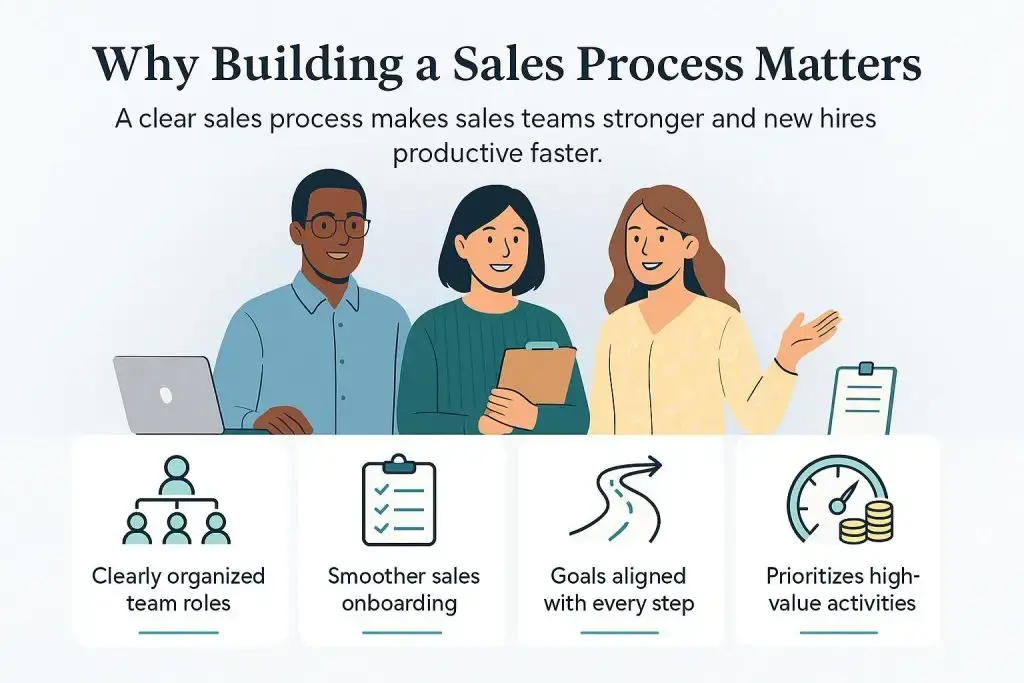
Here are some benefits of building a sales process for your business:
Tip Creating a sales process will not only improve your business’s bottom line, but also help your employees succeed individually. What are the 7 stages of the sales process? There are seven stages in the sales process:
1. Prospect for potential customers The first step is to prospect for customers, which requires some research. This stage has three components.
To perform these three stages, Milenkovic suggested using technology to assist in the process. “Use tools like audience personas, referral networks and outreach channels to build a list of qualified leads,” Milenkovic said. “I also recommend founders use the Value Proposition Canvas from Strategyzer to better understand their customer’s pains, gains and jobs to be done. This makes prospecting more precise and effective.” 2. Make contact with prospects After identifying the ideal prospect, reach out to contact them. “Contacting prospects is the first step toward fitting the product with the prospect,” Ball said. “Sales reps should meet the prospect on their terms and listen more than they speak.” This step has two parts:
3. Qualify prospects Although you have already done your research to qualify the prospect before making contact, you still need to determine if they would make an ideal customer. This can only happen in a direct conversation with the prospect (either over the phone or in person). To qualify the prospect, learn more about them. Ask about their goals, budget, challenges and other issues that will help you to make your decision. Make sure that the person you are speaking with has the power to make decisions on doing business with you. When speaking with the prospect, identify opportunities to provide value. Qualifying the prospect involves confirming whether they meet the criteria of a good customer. If they are not a good fit, tell the prospect why. If they are still interested, determine why. 4. Nurture prospects Once you have qualified the prospect, demonstrate the relevance of your solution to them. This typically involves answering questions about your unique offer, the benefits you provide and the problems you solve. When answering the prospect’s questions and learning about their needs, you have to nurture them along the process of making a decision. “Nurturing prospects through the sales process can look different in different industries,” Ball said. “The one thing that all industries have in common is that prospects are on their own timetables frequently. Nurturing prospects just means that we recognize their timetables but also want to keep the process moving forward toward the sale.” Nurturing prospects involves:
Some prospects may be both interested in your offering and qualified, but might not be ready or able to become a customer at this time. To nurture this type of prospect, stay in touch going forward and demonstrate your ability to help. This will help to keep you at the top of their mind when they are ready to buy. FYI In the third and fourth stages, the prospect might be ready to buy because they need a solution immediately. In this case, move to the next stage. 5. Present your offer Use the information you have collected to this point to present the prospect with your best possible offer. Make the offer personalized, targeted and relevant to your prospect’s needs. Craft the offer to address their challenges, budget and goals. “Share your services or product in a way that solves a real problem,” Milenkovic said. “Everyone is trying to solve a problem and show up as the hero; this is your opportunity to be the solution they’ve been looking for. Be clear about outcomes, pricing and how it works.” While the content of your offer is very important, how you present the offer can be the difference between success and failure. Consider your audience and the situation when deciding how to present your offer. Creativity can be very effective, but you should also focus on what works best for you given the experience of previous presentations. 6. Overcome objections You’ve made the best possible offer — now it’s up to the prospect to make the next move. The most common response is some type of objection to your offer, like those listed below:
Ideally, you addressed the common objections during the nurturing phase or when creating the offer. However, you cannot always address every objection before the prospect makes it. “Address hesitations head-on,” Milenkovic advised. “Understand their concerns: most often these come down to time or money. Acknowledge those realities and help them feel confident in moving forward by showing how your solution saves time, reduces opportunity cost or simplifies their workload.” To overcome or address objections:
7. Close the deal Once you have overcome all objections, you can close the deal to make the sale. First, work on sealing the deal. The goal is to confirm the prospect’s engagement and work toward the next steps. The key is to make it easier for the prospect to say yes to the deal. Prime the prospect by reminding them how they will achieve a specific goal in purchasing your product or service. To close the deal:
“Make it easy to say yes,” Milenkovic said. “Send a proposal, walk them through next steps and provide clear guidance on onboarding or purchase. And don’t forget the follow-up — your urgency to close the deal isn’t always their priority. People get busy. Kind nudges are often welcome and appreciated.” When the prospect has committed to the purchase, answer any additional questions they have and give them details on the next steps. Provide a written agreement and summary of the conversation so their supervisor or other stakeholders can review it for accuracy. If the prospect still responds with “not yet” or “not now” for reasons beyond your control (or theirs), then return the prospect to the nurturing stage. Stay in touch and follow up with prospects who are not ready to purchase.
How do you implement a sales process?
Consider the following approach to implement the sales process in your organization. Understand the customer The sales process begins with the buyer. To implement an effective sales process, you must understand the buyer and then design your sales process to address their goals, motivations and needs. This requires identifying and then answering their “why” question. For instance, why is the buyer looking for a solution? Why are they looking to you for the solution? Build a sales process to help your salespeople find the answer to the key question. Conduct interviews with buyers and salespeople and perform industry research to find the answers to include and increase sales through these tactics. Set milestones Once you’ve defined the stages of your sales process, establish the key steps and milestones within those stages. A milestone could be identifying where the buyer is in the sales process or engaging with stakeholders within a certain time period. Score each milestone to determine how many resources to invest into that part of the sales process. When you set a milestone for each stage, train salespeople to meet that milestone at the assigned stage. This will prevent them from skipping steps or taking the wrong approach at the wrong time (such as talking about the price too soon). Instructing salespeople on when and how to do handoffs will also help correct problems in the sales process. This simplifies the process of helping buyers move from one stage to the next. Apply skills and resources Build skills, resources and activities into the sales process to help your salespeople move to the next milestone. Resources could include brochures, case studies and whitepapers for a salesperson to share with customers. Provide your salespeople with specific training for particular milestones or have them engage in activities for other milestones. Iterate and improve A sales process is not static; it should be refined and improved over time. Get feedback from salespeople, measure buyer behavior, and track and analyze sales data to evaluate the effectiveness of your sales process. To further understand how to iterate and improve the sales process, you need your entire team to be on the same page with training on your consumers’ specific needs. “Small businesses implement a sales process through training and coaching their teams on how to best find the fit between product and prospect,” Ball said. “It is important that all members of a sales team be on the same page with understanding the expectations of the business. By keeping the sales process uniform, this also allows any team member to jump in at any stage of the process, if needed, to move the prospect along to the next stage of the process.” Use the results to solidify the successful activities and resources within the sales process, implement activities and processes to prevent negative outcomes, and remove activities and resources that do not advance the sales process. This will keep the sales process relevant, actionable and efficient. By constantly iterating and improving your sales process, you will:
Align your technology and systems with the sales process Equip your salespeople with technology (such as CRM software) that enables them to perform each step of the sales process efficiently. However, software tools alone won’t make salespeople more effective or encourage them to follow best practices. Combine the technology with supportive systems, guidance and resources. Provide technology that streamlines the sales process, collects and organizes information on customers, and lists the required activities for salespeople to follow. “The critical factor is daily use,” Milenkovic said. “Your CRM is your command center: it helps you track performance, analyze what’s working and adjust as needed. The simpler and more intuitive the system, the more likely a founder will stick with it.” Create systems and resources to support the sales team’s use of the technology during the sales process, such as these:
Amanda Hoffman and Jamie Johnson contributed to the reporting and writing in this article. Want more ideas you can put to work with your team? Explore more practical sales insights →Thinking about strengthening your B2B sales team? Learn more about our B2B sales training & coaching →
Written by: David Gargaro, Senior Writer, Business.com
David Gargaro has over 25 years of hands-on experience in the business arena. In 2018, he penned "How to Run Your Company… into the Ground," drawing insights from his direct involvement in small business operations. His practical guide covers a spectrum of topics, including strategic partnerships, product development, hiring and expansion strategies. At business.com, Gargaro provides guidance on business insurance (errors and omissions, product liability, workers' compensation, etc.) and sales (sales funnels, lead generation, building a sales process, etc.). Gargaro has also developed toolkits for startup founders, assisting them in navigating the complexities of entrepreneurship. He is a professional speaker as well, addressing audiences on topics such as the customer experience. Additionally, Gargaro's expertise in sales, marketing and financial planning has been featured in publications like Advisors Magazine, Moody's Analytics and VentureBeat. Stay Connected Monthly Sales InsightsReceive one practical sales insight each month to help your B2B team strengthen sales execution, improve pipeline quality and build forecast confidence. One email each month. Unsubscribe anytime. 
Sales teams operate at their best when each team member is motivated, enthusiastic and knowledgeable about the products and services they’re selling. That attitude isn’t something that just happens by chance, but rather is cultivated by managers and employers. Building a better sales culture involves a deliberate strategy and understanding what motivates your salespeople, and it can be a vital aspect of your business’s success.
What is a sales culture and why is it important? The term “sales culture” refers to your sales team members’ attitudes, values and habits. A winning sales culture usually can be summarized in a few words describing their values, such as “ethical,” “motivated” and “professional.” “In a positive sales culture, people are more focused on helping each other in the team,” said Sabir Naghiyev, a business coach and founder of Chrysales. “Also, [a positive sales culture is] not money focused, but rather [focused] on helping and supporting the client. A positive sales culture increases your team’s buy-in and makes every representative a sales leader. Additionally, your team dynamics will improve and individual sales reps are more likely to strive for professional growth and development. Your sales culture defines how salespeople are expected to interact with each other and potential customers. Without a clearly delineated and positive sales culture, no sales strategy is complete and sales success may be limited. “If a culture is positive, people feel great and make the clients feel great,” Naghiyev said. Most businesses are well aware of sales culture problems — and that a negative sales culture can hinder success. “The best way to understand it is to ask questions and observe team members,” Naghiyev said. Signs you need to change the workplace culture in your sales department include the following:
How do you build a positive sales culture? Here are nine ways to build a positive sales culture. 1. Hire salespeople slowly and deliberately. While growing employees is key to growing your business, many fast-growing companies often “panic hire” anyone with adequate qualifications to meet demand. However, settling for “adequate” employees can kill your sales culture. [Read Related: How to Improve Your Hiring Process] Instead, take time to hire people who fit your company’s culture overall and your ideal sales culture specifically. Make a checklist of the characteristics your ideal salespeople will need to create a cohesive sales organization. They must be able to communicate your company’s mission and vision to potential customers. For example, say your sales organization prioritizes teamwork. In this case, your human resources (HR) department might seek recent college grads who were collegiate athletes and know how to work as a team to achieve goals. Gather your leadership team and work together to define your sales culture and the characteristics your salespeople must embody to succeed within it. 2. Monitor your sales team’s daily activities. A nurse or doctor wouldn’t glance at you and give you a diagnosis. They would run tests, analyze your situation, explain what’s happening and suggest a treatment plan. You must do the same for your sales team. Take a metrics-based approach to managing your sales team’s daily activities and goals. However, don’t let those metrics stand in the way of genuine human interaction, positive reinforcement and the chemistry needed for an excellent sales team. “Detailed sales data and KPIs are the best way to track how changes to the company’s sales culture have evolved over time,” said Al Alof, founder and CEO of cryptocurrency exchange ChicksX.com. “Beyond profits, we also consider other areas, such as customer satisfaction, employee growth and engagement within the company, and the company’s overall expansion.” A deep understanding of the sales pipeline — from first contact to closing — gives sales leaders the necessary data to make adjustments that increase productivity and boost team happiness. For example, say a sales manager examines a key performance indicator (KPI) that indicates a rep should follow up with a lead sooner. They can use this information to encourage behavioral changes. This approach can help foster a positive sales culture. 3. Acknowledge successes and failures. Celebrating when your team hits a sales goal is crucial to building a strong sales team that’s willing to go the extra mile. But you must also discuss failures and goals that fell short positively and constructively. Don’t criticize the team if sales aren’t as high as hoped. However, discuss their challenges so you can address them and help improve next month’s sales goals. Creating a culture of learning, understanding and growing can encourage a positive sales culture. 4. Drum up some healthy competition. Stirring up healthy workplace competition can boost results and strengthen your sales culture. However, it should be fun, not stressful. Eliminate and avoid negative behavior and encourage your reps to cheer each other on. For example, create sales contests that compel team members to work diligently and ensure the stakes aren’t too high — you don’t want your team to feel resentful. While individual competition is often natural for sales reps, try focusing on team goals so everyone works toward a common objective. If your sales situation includes territories, ensure every territory is outlined clearly so your reps aren’t tempted to poach clients or undermine each other. 5. Emphasize activity over results. Sales are all about numbers and that won’t ever change. Whoever sees the most qualified prospects in the least time has the best chance of high sales. Salespeople can’t fully control who buys and who doesn’t. For this reason, sales managers should encourage teams to increase their activity to boost their results. Activity, of course, includes quality service and follow-through. “Shift the focus from ‘closing deals’ to ‘solving problems,’” said Julie Thomas, president and CEO at ValueSelling Associates. “A positive sales culture emphasizes understanding customer needs, delivering tailored solutions, and building long-term relationships.” To foster your team’s long-term success, keep activity high while establishing a repeatable sales process that focuses on sales message quality. Automated marketing solutions can help by customizing messages based on prospect behavior. With this guidance, the salesperson knows the prospect’s interests before making a sales pitch. 6. Boost salespeople’s self-esteem. Salespeople are often the highest-income earners in your business, but that pay doesn’t come easily. Salespeople have a difficult role and unique challenges because they battle rejection daily. If you want them to produce, you must share how honorable it is to be a sales rep for your company. Put the position’s importance on a pedestal and highlight how pivotal it is to the success of your business. “Motivating your sales team and celebrating your wins go hand-in-hand,” said Tip Moore, VP of sales at Tango Card. “So, don’t miss the chance to recognize and amplify these outstanding efforts.” Moore recommended showing appreciation by giving your sales team gift cards at the end of each year, acknowledging how hard they pushed to reach year-end goals. For sales teams, Moore added, the end of Q4 is a stressful time, so these gifts are usually highly appreciated. 7. Learn to recognize your team’s successes. Recognize your sales team’s leaders publicly. Creating an incentive plan that drives activity is a quick way to boost results. Employee bonuses and prizes are often tied to production, but even affordable incentives can result in an immediate activity spike. Remember to maintain a high-energy environment. Working in sales can crush even the biggest of egos as positivity is necessary to keep your employees persevering in the face of rejection. Keep things light with friendly competition, publicly acknowledge your top salespeople and share tips for success. Gamifying sales and publicly rewarding successes is a great strategy that can motivate your team. 8. Master the process of training your salespeople. Investing in employee training pays dividends, giving them the tools necessary for success in their position. Positive sales cultures have systems that help salespeople learn and achieve their goals. Training is crucial for new employees, but ongoing professional development for your sales team is also essential. “Embed a proven framework … to ensure sellers consistently uncover and communicate value to buyers,” said Andy Springer, chief client officer at RAIN Group. “It’s also important to reinforce buyer-centricity. Align the team around helping buyers achieve their goals, emphasizing needs discovery and solution crafting as a standard practice. “Also, foster learning and improvement,” Springer added. “Build a culture of continuous improvement with regular sales training, coaching, and playbook reviews.” Observe reps on phone calls and offer ideas as they plan how to approach prospects. Third-party training courses are helpful, but the most important thing is to get your sales team to share ideas and best practices. 9. Reduce time spent on meetings and paperwork. By nature, salespeople are go-getters who want to be engaged in generating new business. Since they are also among your most valuable employees, it makes sense to let them spend the vast majority of their time doing what brings them satisfaction — and brings you revenue. While team-building exercises are great, try to limit the time your reps spend in sales meetings. A good sales pipeline tracking system can also help limit the time it takes to create sales reports, freeing your sales reps for more vital activities. What makes a successful sales team? The hallmarks of a successful sales team extend beyond what can be taught in sales coaching. “A strong sales culture leads to a deeper and clearer understanding of the sales process, which in turn leads to more sales, better customer satisfaction, and better customer retention,” Alof said. A successful sales team does the following:
Building a sales culture does take time and effort, but when your sales team is highly engaged and satisfied it shows in their work. If you want to keep growing your business and driving new revenue, start by creating a positive sales culture that generates buy-in across your entire team. Want more ideas you can put to work with your team? Explore more practical sales insights →Thinking about strengthening your B2B sales team? Learn more about our B2B sales training & coaching →
Written by: Megan Totka, Senior Writer, Business.com
Megan Totka is the Chief Editor for ChamberofCommerce.com. She specializes on the topic of small business tips and resources. ChamberofCommerce.com helps small businesses grow their business on the web and facilitates connectivity between local businesses and more than 7,000 Chambers of Commerce worldwide. Stay Connected Monthly Sales InsightsReceive one practical sales insight each month to help your B2B team strengthen sales execution, improve pipeline quality and build forecast confidence. One email each month. Unsubscribe anytime. 
Everyone is an actor to a certain extent, and this is especially true in the world of sales. Sales representatives are under incredible pressure to deliver presentations in front of customers and clients while exhibiting competence, confidence and empathy. These presentations are, in a way, performances. So, what better way to prepare for these performances than role-playing?
How to use role-playing with your sales team Since a company’s ability to secure a customer or client often depends on a salesperson’s skills, it is vital to build a highly skilled sales team and a positive sales culture. To achieve this, you’ll want to teach and reinforce the critical sales skills that will help your company meet its performance goals. Role-playing is a particularly helpful training technique that engages your sales team in real-world selling scenarios and enhances their knowledge, attitude and skills. Business owners should implement this training method to instil confidence in their reps before they go out into the field. “I have often used role play to great effect within presenting and pitching,” said Emma Orr, business development consultant and Winning Business UK Ltd. “The best use of this I have found is in a face-to-face meeting, usually at the final stage of a sales process.” Below are strategies for effective role-playing with your sales staff. 1. Start with customer research. You need certain benchmark data to develop meaningful sales training and role-playing scenarios. Consider the following questions: Why do your customers choose to do business with you? What are their drivers? For your prospects who went elsewhere, what factors influenced their buying decision? Why didn’t you get the business? You can ask your sales reps these questions, but they may be too close to the situation to give you objective feedback. Nothing beats getting perspective straight from your customers, so conduct client interviews prior to your sales training so you can share and incorporate the results into your role-playing exercises. “Often there is too much focus on the business selling — how great they are, etc.,” Orr said. “Once you change the narrative to be more focused on the client, [the] results become far greater.” 2. Create a safe environment. Sales managers and training facilitators should explain at the outset that role-playing requires a safe, positive and respectful environment to bring out the best in participants. As each exercise unfolds, let your team know there are no wrong answers. After all, employees can only engage in the training and improve their performance in a workplace where they feel supported and safe. “If a [sales] rep focuses on practice in a controlled environment, this will enable them to try out ideas without the risk of failure …, which prepares them well and boosts their confidence in real sales,” said Will Yang, head of growth and marketing at Instrumentl. Give your employees room to make mistakes while role-playing. This assures them that you care about their success and want them to grow. [Find out why businesses should invest in employee training.] 3. Provide message training. Role-playing can be especially powerful when participants rehearse cold calls, elevator pitches, key sales messages, corporate presentations and price negotiations. Message training also helps ensure your sales reps speak about your brand in a consistent and compelling manner. 4. Share successes. Success stories detailing key wins can be very motivating. Break each story down and analyse what went right and why so your entire team can learn by example. Feature your top salespeople in a best practices panel discussion and encourage other reps to ask them probing questions. Sharing success stories and finding opportunities to learn from one another encourages the rest of the team to believe they can overcome their own hurdles and achieve similar results. 5. Dig deeper. Educating your sales reps about price, features and benefits is essential but devote discussion to the psychological reasons customers buy as well. Knowledge of consumer behaviour can help your sales reps close more deals. Experiment with different customer types and client personalities in your role-playing exercises. See more on this in the examples below. 6. Reduce the pressure. Role-playing should make employees feel more at ease. Let your team know that it’s OK to make mistakes as they act out different situations. The more comfortable your team feels during role-playing, even when put on the spot, the more likely they will take what they’re learning to heart and put their training into practice. 7. Demonstrate specific scenarios. Present common objections and scenarios your sales team members will likely encounter, such as dealing with competitors or challenges introducing a new product. Based on the different circumstances, have your team act out creative solutions to close the sale. The customer research you did in advance can help simulate the specific situations your reps are likely to face. 8. Identify key takeaways. End each role-playing session by recapping the key takeaways. Based on what team members learned by participating in and witnessing the exercises, have them identify the areas they should improve and where they are already doing well. Everyone should walk away from the training with new sales strategies and insights into what it takes to be a successful salesperson for your business. 9. Make role-play training an ongoing event. Repetition is the key to mastering any skill. Therefore, role-playing with your sales team should not be a one-time endeavour. You may need to do it regularly, even once a week, for your reps to learn as much as they can and hone their skills continually. Role-playing is often the easiest way to teach salespeople communication skills and to analyse their daily performance and challenges. Fortunately, the only thing it’ll cost you is time. “Sessions should be conducted regularly to kindle [best] practices and spur improvements,” Yang said. “Seek suggestions from colleagues whenever possible to ensure that the entire sales team does not rely on a single session and can offer and fit in multiple solutions.” The benefits of role-playing in sales training Just like Broadway actors, good sales performers need to practice their lines before they go live — and increased sales may result. Businesses should incorporate role-playing into their sales training because: It allows sales reps to experience real-life sales scenarios and gain confidence in their abilities. When role-playing real-life sales situations, your sales reps will gain experience dealing with a variety of challenges, such as gruff potential clients or customers who don’t know what they want to buy. Your team members will navigate these role-playing scenarios in a stress-free and safe setting. This will allow them the freedom to explore in a consequence-free environment where they can build up their confidence for navigating these challenges when selling in the real world. Orr suggested that role-playing participants speak from a target customer’s viewpoint to simulate real-life scenarios. “We talk from [customers’] perspective, almost a look into the future of what life could be like if they work with us,” she said. “[For one target customer], it might be increased sales, greater customer retention, [or] improved reviews, whereas [another target customer might want] fewer complaints, happy customers, [or] more [fulfilment] in their job.” It improves listening and communication skills. A critical component of good role-playing and good salesmanship is strong listening skills. Your sales reps need to be able to listen closely to what their prospects are saying and pay attention to nonverbal cues and body language. This way, they will be attuned to what the customer needs. Role-playing gives employees opportunities to practice their listening skills and different communication styles so they’re prepared for interactions in the field. It provides sales reps with the opportunity to develop creative problem-solving skills. Even though salespeople can practice out-of-the-box scenarios when role-playing, surprising and outlandish challenges arise in real-life sales pitching that even a whole sales team cannot anticipate. Nevertheless, imaginative role-playing allows your team to develop creative problem-solving skills to better navigate such scenarios during real sales pitches. The more your employees work on problem-solving in these fictional situations, the more they’ll be able to apply such skills during the real thing. It is efficient to learn in a group setting. Since your sales force is learning as a group, everyone will benefit from exposure to a multitude of perspectives and scenarios in a short time frame. They can give feedback to each other, provide pointers for different situations and be exposed to tactics they might not have thought of otherwise. In this sense, role-playing sessions can be more efficient than individual training. Plus, these exercises can fuel teamwork in the workplace that isn’t limited to sales activities. [See the habits effective teams have in common.] It lets salespeople get feedback from multiple team members. Role-playing with team members allows your sales reps to get feedback from people at all stages of their careers with a wide range of experiences. While one-on-one coaching and mentoring relationships can be beneficial, the person being mentored is limited to the guidance their individual coach can offer. In contrast, role-playing incorporates multiple perspectives, which allows for more well-rounded instruction. Sales role-playing examples & scenarios To help you establish sales role-playing exercises, examples of scenarios your team can practice are listed below. Keep in mind that while the basics of the sales process are consistent from company to company, the most effective role-playing sessions will be based on customer research specific to your client base and the experiences your salespeople regularly have. It’s always best to tailor your role-playing situations to your business. 1. Role-playing with an indecisive customer Indecision is a normal customer emotion during the buying journey. Some prospects are so overwhelmed with information that they experience decision paralysis. For these situations, you’ll want to practice persuasiveness techniques so you can convince the customer to make a purchase and close the deal. 2. Role-playing with a detail-oriented customer Some prospective customers enter sales meetings with a thorough understanding of what you’re selling. They’ve already done their research, so a cold-call-type pitch is unlikely to be effective. Instead, sales preps should practice answering in-depth questions and be prepared to cover even the most intricate details. 3. Role-playing with a distrustful customer Just because a prospect agrees to hear your pitch doesn’t mean you’ll have their true attention. Some people are inherently disinterested in what salespeople have to say because they don’t trust them. Practicing relationship building can help sales reps win over distrustful prospects. 4. Role-playing with your typical customer Orr recommended using your sales team’s typical target audience in your role-playing. As an example, she relayed her own experience role-playing a standard hospitality sale. “[I] and two colleagues will often “dress up” — wear name badges, a hat, etc. — and we usually play the role of three people: the CEO, the general manager and the receptionist,” she said. “This can be a bit silly but is also memorable and helps us to stand out. It changes the psyche of the customer when positioned differently.” 5. Role-playing with customers who raise objections It’s far from unheard of for sales prospects to object to pricing. There are also many more unusual objections your sales team could encounter — really, anything is on the table. Role-playing can help your team expect the unexpected and respectfully address objections in ways that make sales more likely. 6. Role-playing to reach decision-makers Sometimes, the audience for a sales pitch lacks decision-making power, requiring the salesperson to get access to someone with more authority. Role-playing this scenario can help your team figure out how to reach these decision-makers. Or, for scenarios when the decision-maker is present, role-playing can guide your salespeople toward tactics that often persuade hesitant spenders. 7. Role-playing to position your business above its competitors Sales prospects who have deeply researched your industry may ask you how your products or services outperform your competitors. Role-play this scenario with your team — it’s one of the easier situations to work through together. Your salespeople can research your competitors beforehand and go into role-playing with coherent arguments in your favor. 8. Role-playing negotiation with an interested customer Certain prospects will only say yes after negotiating on the package or price you offer. Role-play this scenario with your salespeople to teach them how to meet the customer’s needs without sacrificing your company’s goals. Simulate a meeting in which a prospect asks your salesperson to come down on price to beat out a competitor, and help your salesperson secure the deal without slashing your revenue. 9. Role-playing with a customer looking to rush into an agreement Top-quality products and services often take some time to properly implement or provide. However, some sales prospects may demand you start doing so in a time frame shorter than what’s feasible for your company. Role-play this scenario with your salespeople so they can show a prospect they understand this desire while mapping out a more realistic timeline. 10. Role-playing with a withholding customer Making a sale requires active listening to a customer’s needs — but what if a customer just isn’t sharing this information? This scenario requires some extra work on the salesperson’s part to develop enough trust with the prospect that they start elaborating. Role-playing this situation can help your salespeople transform withholding customers into more forthright ones. 11. Role-playing with customers from different cultures or countries Business etiquette differs around the world and gaps in cultural customs may emerge during a sales meeting with international prospects. Namely, a prospect’s verbal communication and body language may feel unfamiliar or confusing to a salesperson and vice versa. Instead of asking your salespeople to memorize different cultures’ customs, role-play how to detect different etiquette standards and adjust accordingly. 12. Role-playing when there’s a plot twist A smooth process that seems likely to yield a sale can be suddenly derailed by new wants or needs on the prospect’s side. This jarring scenario requires quick problem-solving that’s respectful, considerate of the prospect’s goals and feasible for your company to implement. Role-play this scenario so that your team can be adaptable, confident and level-headed as these plot twists emerge. 13. Role-playing when there’s more than one prospect Selling to a company may involve persuading more than one decision-maker. Each decision-maker might have different wants and needs, so role-play this scenario to train your sales team on how to balance all these desires and goals. Doing so can feel overwhelming, but after role-playing this scenario, it might become a total cakewalk. Playing the role of a great salesperson Try role-playing with your team to maximize their chances of getting your prospects to make a purchase. After all, team members who can simulate being great salespeople are more likely to be actual great salespeople out in the real world. The best part? Role-playing costs no extra money — it’s a return on investment if there ever was one. Want more ideas you can put to work with your team? Explore more practical sales insights →Thinking about strengthening your B2B sales team? Learn more about our B2B sales training & coaching →
Written by: Mark Fairlie, Senior Analyst, Business.com
Mark Fairlie brings decades of expertise in telecommunications and telemarketing to the forefront as the former business owner of a direct marketing company. Also well-versed in a variety of other B2B topics, such as taxation, investments and cybersecurity, he now advises fellow entrepreneurs on the best business practices. At business.com, Fairlie covers a range of technology solutions, including CRM software, email and text message marketing services, fleet management services, call center software and more. With a background in advertising and sales, Fairlie made his mark as the former co-owner of Meridian Delta, which saw a successful transition of ownership in 2015. Through this journey, Fairlie gained invaluable hands-on experience in everything from founding a business to expanding and selling it. Since then, Fairlie has embarked on new ventures, launching a second marketing company and establishing a thriving sole proprietorship. Stay Connected Monthly Sales InsightsReceive one practical sales insight each month to help your B2B team strengthen sales execution, improve pipeline quality and build forecast confidence. One email each month. Unsubscribe anytime. 
Today’s employees understand their value and have no problem seeking a new position if their current employer doesn’t properly utilize their skills and potential. Amid struggles with talent acquisition and retention, strategic business owners are prioritizing employee development to reduce turnover, boost innovation, deepen employee loyalty and create a positive company culture. We’ll outline six reasons why investing in employee training is crucial and share types of training that can help take your organization to the next level.
Why businesses should invest in employee training Extensive and thoughtful employee training can improve company morale and talent retention, ultimately saving your business money. Consider the following top reasons to invest in employee training. 1. Investing in employee training helps attract and retain talent. Providing high-quality training and employee development programs can help businesses improve recruitment efforts and boost employee retention. According to imc Learning, 92 percent of job seekers will choose a business that provides robust training over a similar option. Additionally, 52 percent of employees have left a role due to a lack of training and advancement opportunities — and 86 percent said they’d stay with their current employer if training opportunities were available. A business that prioritizes employee training strengthens its recruitment and retention efforts while positioning itself as a leader in employee satisfaction and development. 2. Investing in employee training can help you identify promotable employees. Interestingly, in SHRM’s 2024 Talent Trends report, 35 percent of human resources (HR) professionals say training existing employees to take on hard-to-fill positions is a top-utilized recruitment strategy. When you identify and mentor talented team members to move into crucial positions, you save money on recruitment and leadership succession by developing qualified professionals who understand the company culture and goals. “Dedicated training programs specifically designed for succession create a ready pipeline of leaders at all levels, reducing emergency hiring and ensuring business continuity,” explained Amy Spurling, CEO and founder of the HR technology company Compt. Identifying employees to promote from within also saves money, boosts retention and speeds onboarding. “Training your employees to have skills across multiple areas will make it easier to fill internal vacancies and reduce the need for external hires,” said James Zhong, an operations manager at RJ Living who oversees the company’s HR. “This will make your team more flexible and open to change should the need arise.” 3. Investing in employee training can increase employee engagement. Training your employees is an excellent way to give them a break from their usual work and potentially expand their interests. Participating in interesting and productive projects and activities, such as training programs and professional development courses, can help promote employee happiness and improve employee engagement. As a bonus, engaged employees tend to be loyal. They know you’re willing to invest resources to improve their skills and careers and appreciate your commitment to their future. According to LinkedIn’s 2024 Workplace Learning Report, 80 percent of surveyed employees say learning and development opportunities add a sense of purpose to their work, and 70 percent say they feel more connected to their employer when given such opportunities. Additionally, SHRM data revealed that 76 percent of surveyed employees are willing to stick with a company that offers continuing learning and development opportunities. The bottom line is that your willingness to invest in your employees’ training and development inspires them to invest as much hard work as possible into your business. 4. Investing in employee training can save a business money. Effective training programs can empower employees to hone new skills and extend their talents across various areas. Businesses can tap these multi-skilled employees to handle various functions and easily transition them to new organizational roles. This approach saves the business money on recruitment, onboarding and training costs. Additionally, trained employees are less likely to make costly errors because they better understand processes and expectations. Well-trained employees also tend to work more efficiently, which improves productivity and reduces the need for overtime or hiring additional staff. “Businesses and industries are changing, and investing in employee training will make [companies] more able to adapt to new challenges, technologies and processes,” Zhong said. “If there are sudden changes or periods of transformation, having this sense of adaptability will make it much easier to maintain productivity.” 5. Investing in employee training helps shape an organization’s future. Businesses that incorporate training and development programs consistently refine and update their offerings. This attention to detail makes these organizations more responsive to employees’ needs, interests and goals while helping them stay on top of industry trends. “Training isn’t just about solving today’s problems — it’s about preparing for tomorrow,” explained Tim Glowa, founder at HRbrain. “Tailored programs can address future skill gaps and help businesses stay competitive as industries evolve. Many organizations now are focusing on analytics and AI [artificial intelligence] and encouraging employees to develop these skills, helping [bring forth] the company of tomorrow.” Spurling emphasized the importance of incorporating industry trends and competitor offerings into employee training programs. “Well-trained employees better understand industry trends and competitor moves, helping your company stay ahead of market changes rather than just reacting to them,” Spurling noted. 6. Investing in employee training boosts innovation. Spurling noted that gathering employees across teams for unified training can lead to solutions that might not have emerged otherwise. In other words, employee training — when conducted with all teams in the same room — can be a direct conduit to team innovation. “When employees from different departments train together, they spark new ideas that can transform your business,” Spurling said. “[Compt’s] engineers and customer success team often work together to inspire product improvements with direct customer feedback that we never would have considered otherwise.” How to invest in employee training Here are a few ways to implement effective employee training in your business. Create mentorship opportunities. Mentorship programs are an effective way for companies to attract new employees and connect workers with skilled professionals who can guide and support them. Through mentorship, employees at all levels can strengthen their skills and feel empowered by partnering with a professional in their field who provides valuable guidance and advice. Mentorship programs can be structured formally or informally in a one-on-one or group setting led by one mentor. Sessions can occur as often as participants prefer — whether weekly, monthly or quarterly. Provide access to online and offline learning resources. Online learning platforms, such as LinkedIn Learning, are a cost-effective and easy way for employers to train team members. These platforms use insights from outside industry experts on topics that span various subjects, including business and technology. They’re a way for companies to provide elevated training for their employees without having to create new and original content themselves. Spurling suggested pairing online resources with internal in-person training. “For example, pair LinkedIn Learning courses with internal mentor sessions for maximum impact.” Companies can use online learning subscriptions as supplemental materials or incorporate lessons as part of the training program’s curriculum. Alternatively, they can use the learning platform as an autonomous solution for workers to strengthen their skill sets independently. Start a learning and development department. Creating an HR department focused on learning and development can help your company strengthen and invest in employees’ skills while boosting engagement and retention. According to the LinkedIn Workplace Learning report cited earlier, 90 percent of organizations are concerned about retention and see learning opportunities as their number-one retention strategy. This creative perk can also be a big selling point during the hiring process, demonstrating that your company is willing to invest in empowering its employees. Zhong emphasized the importance of providing engaging microlearning opportunities. “You don’t have to do everything all at once,” Zhong advised. “You can easily incorporate bite-sized, on-demand training modules to make learning more accessible to your workers, which will also lessen the chance of [training] disrupting their daily processes. It also means that people can move at their own pace.” Provide frequent and informal reviews. Employees can’t improve in their roles if they are unsure about what needs to change. To keep employees motivated and engaged, regularly check in to provide feedback and support, see if they need anything additional to succeed and discuss any roadblocks they’ve encountered. Don’t wait to provide feedback during an annual review — this can unintentionally create an unhealthy environment where employees view reviews as a significant and stressful endeavour. Instead, encourage open communication by giving informal feedback more frequently. This approach allows employees to swiftly implement suggestions and improve themselves. Spurling suggested basing feedback loops on metrics so employees know how and where to improve. “Track not just [employee training program] completion rates but actual skill application,” Spurling advised. “Have managers document when and how employees use their new skills to justify future training investments.” Offer professional development workshops. Hosting recurring workshops across a wide range of topics can be beneficial in developing employees’ skill sets. Providing professional development workshops that cover skills like time management, public speaking and professional relationship development can help employees across all departments become more well-rounded, motivated and engaged. This approach benefits both remote and in-person teams — sometimes, remote teams are more engaged than office workers. Notably, you and your company don’t have to do all the teaching yourselves. Bringing in experts as featured guests to facilitate workshops may be a more effective option. Leverage cutting-edge technology to optimize your training. Determining the areas where your employees need the most training can be tricky. Glowa noted that AI has made this challenge much easier to address. “AI is revolutionizing training by identifying skill gaps, recommending targeted upskilling and aligning growth opportunities with business goals,” Glowa explained. “It’s a game-changer for personalizing employee development and building a resilient workforce and [it] provides an essential way to aid development that many employees are missing.” Types of employee training to consider Employee training isn’t a one-size-fits-all endeavour. Effective programs include many types of training, including the following:
Tips for effective employee training Employee training requires attention to detail, organization and an understanding of the trainee’s abilities. Consider the following best practices for effective employee training:
There’s no right or wrong way to train your employees As you develop your employee training program, you’ll start to see which approaches are and aren’t effective for your team’s learning. Your program certainly isn’t set in stone, so adjust your training as frequently as necessary and to whatever extent you require. Keep at it, and your vast talent pool might become even more talented — and become an obvious set of employees to lead the company’s future. Want more ideas you can put to work with your team? Explore more practical sales insights →Thinking about strengthening your B2B sales team? Learn more about our B2B sales training & coaching →
Written by: Max Freedman, Senior Analyst, Business.com
For almost a decade, Max Freedman has been a trusted advisor for entrepreneurs and business owners, providing practical insights to kickstart and elevate their ventures. With hands-on experience in small business management, he offers authentic perspectives on crucial business areas that run the gamut from marketing strategies to employee health insurance. At business.com, Freedman primarily covers financial topics, including debt financing, equity compensation, stock purchase agreements, SIMPLE IRAs, differential pay, workers' compensation payments and business loans. Freedman's guidance is grounded in the real world and based on his years working in and leading operations for small business workplaces. Whether advising on financial statements, retirement plans or e-commerce tactics, his expertise and genuine passion for empowering business owners make him an invaluable resource in the entrepreneurial landscape. Stay Connected Monthly Sales InsightsReceive one practical sales insight each month to help your B2B team strengthen sales execution, improve pipeline quality and build forecast confidence. One email each month. Unsubscribe anytime. |

Paul Mason
|

© Touchstone Training & Coaching 2026 · Western Sydney, NSW · Q-RED™ Sales System · Sales Training · Sales Coaching
Serving Western Sydney commercial & industrial hubs: Parramatta · Macquarie Park · Norwest · Penrith · Liverpool · Eastern Creek · Wetherill Park · Smithfield · Erskine Park · Prestons · Ingleburn