
Touchstone Training & Coaching
  • Home
  • Q-RED™ Sales System
  • Training & Coaching
    • Sales Training
    • Sales Coaching
  • Industries
    • Manufacturing
    • Construction & Infrastructure
    • Engineering & Technical Services
    • Transport & Logistics
    • B2B Technology & Solution Sales
    • Professional Services
  • Resources
    • Sales Health Check
    • Sales Performance Diagnostic
    • Sales Insights
    • Sales Library
    • Q-RED™ Foundations
  • About
  • FAQs
  • Contact

SMEs’ Toughest Time of the Year: How Strategic Sales Training & Coaching Can Ease the Pressure

24/11/2025

0 Comments

 
Picture

End-of-year pressure can challenge any SME. Learn how strengthening sales capability through targeted training and coaching helps your team stay focused, motivated, and ready for the new year.

For many Western Sydney SMEs, the final months of the year are consistently one of the toughest periods. Sales pipelines slow down, teams feel stretched, operational pressure peaks, and leaders must balance finishing the year strongly with planning for the next. It’s a perfect storm of fatigue, uncertainty, and competing priorities — and it often exposes gaps in consistency, capability, and confidence across sales teams.

The encouraging news is that these challenges are predictable, manageable, and often eased through one key approach: strengthening your team’s capability through strategic sales training and targeted sales coaching.

Whether your business develops these skills internally or draws on external support, enhancing sales capability now can ease the pressure of this demanding period and help set the foundation for a stronger start to the new year.

This guide explores why this time of year is uniquely difficult for SMEs, and how effective sales training and coaching can lighten the load.


Why This Time of Year Is Particularly Challenging for SMEs

While every industry has its unique cycle, many SMEs across Western Sydney — from manufacturing and construction to logistics, B2B trades and professional services — tend to experience the same end-of-year pressures.

Below are the most common challenges faced by SME sales teams during this period.

1. Sales Pipelines Slow Down Just When Targets Matter Most

As the year winds down, B2B buying behaviour slows considerably. Clients delay decisions, become harder to contact, or push discussions into the new year.

This creates:

  • Revenue uncertainty
  • Difficulty forecasting
  • Stalled deals
  • Unpredictable short-term performance

For smaller teams, a small number of delayed decisions can disproportionately impact results. This slowdown reflects seasonal behaviour rather than poor performance — but it can still create stress.

2. Teams Experience Fatigue, Lower Capacity, and Reduced Momentum

By November, most teams feel the effects of a long year. Workloads increase as clients rush to finalise projects, and internal energy naturally dips.

Fatigue can lead to:

  • Slower follow-up
  • Reduced activity
  • Less consistent messaging
  • Lower confidence in conversations
  • Difficulty staying organised
  • A drop in motivation

SMEs feel this more intensely because they rely on leaner teams where every salesperson makes a noticeable difference.

3. Leaders Must Plan for the New Year Without Complete Visibility

End-of-year planning requires leaders to:

  • Review team performance
  • Set revenue targets
  • Allocate training and development budgets
  • Identify capability gaps
  • Refine sales priorities for the new year

This is challenging at the best of times. It becomes even harder when pipelines are slowing and teams are fatigued. Leaders must balance immediate performance needs with longer-term strategy — often without the clarity they’d prefer.


How Strategic Sales Training & Targeted Sales Coaching Can Ease the Pressure

Sales training and coaching are not “nice-to-have” activities during this period — they are practical tools that help stabilise performance, support teams, and create clarity for the year ahead.

Importantly, this capability development can come from internal leaders, external assistance, or a blend of both. What matters most is that it is structured, consistent, and aligned with your team’s needs.

Here’s how sales training and coaching can make this tough period more manageable.

1. Sales Training Helps Teams Stay Proactive When the Pipeline Slows

Training gives teams the practical skills and renewed structure they need to manage quieter periods more effectively.

It can help salespeople:

  • Re-engage stalled prospects with better messaging
  • Improve qualification to prioritise high-value opportunities
  • Use value-led follow-up strategies
  • Create clear next steps to maintain momentum
  • Secure meetings for early January before the break
  • Avoid slipping into “wait and see” mode

These skills help SMEs maintain control over their pipeline, even when external activity slows.

2. Coaching Supports Individuals Through Fatigue and Pressure

Targeted coaching — delivered internally or externally — provides ongoing support when teams need it most. It creates space for individuals to reset, refocus, and stay on track.

Coaching helps team members:

  • Maintain consistent activity
  • Identify simple improvements
  • Stay accountable to key actions
  • Rebuild confidence when it dips
  • Manage workload more effectively
  • Handle pressure without becoming overwhelmed

This support structure helps prevent performance from tapering off during the toughest stretch of the year.

3. Training & Coaching Give Leaders Clearer Insight for Next Year’s Planning

The end of the year requires leaders to make informed decisions — and that’s easier when they have clarity around team capability.

Training and coaching can reveal:

  • Strengths and skill gaps
  • Inconsistencies in the sales process
  • Where conversations tend to break down
  • Opportunities to improve conversion rates
  • Where time and effort may be misdirected
  • Which capabilities matter most for the new year

This insight enables better planning, clearer priorities, and more effective development pathways for the year ahead.

4. Development Opportunities Help Retain Talent During a High-Risk Period

December–January is one of the highest turnover periods in the Australian workforce. People take stock of their year and often reconsider their direction.

Providing development opportunities can:

  • Boost morale
  • Improve engagement
  • Strengthen loyalty
  • Increase clarity and confidence
  • Signal investment in your team
  • Improve long-term performance

Retention is a major challenge for SMEs — and capability development helps build stability.

5. Training & Coaching Set Up a Faster, Stronger Start in January

Most businesses begin the new year slowly. A combination of training and coaching delivered late in the year helps teams return with renewed focus and capability.

It supports a strong start by enabling teams to:

  • Return to work with clarity
  • Re-engage clients quickly
  • Apply refreshed skills
  • Rebuild positive habits
  • Avoid the typical post-holiday lag
  • Accelerate early-year momentum

This can create a competitive advantage going into Q3.


A Valuable Investment at the Right Time

The end of the year can feel heavy for SMEs and their sales teams — but it also presents an opportunity. Strategic sales training and targeted sales coaching can ease the pressure by helping teams stay focused, capable, and confident through the most demanding period of the year.

Whether delivered internally by your leadership team, externally by a specialist, or a blend of both, investing in capability now can help your organisation finish the year strongly and start the next with clarity, structure, and momentum.


For Western Sydney SME leaders who want to support their sales teams through this period and into the new year, you can review our B2B sales training, sales coaching, and Q-RED™ Sales System options, or visit Touchstone Training & Coaching to get in touch.

Want more ideas you can put to work with your team?

Explore more practical sales insights →

Stay Connected

Monthly Sales Insights

Receive one practical sales insight each month to help your B2B team strengthen sales execution, improve pipeline quality and build forecast confidence.

One email each month. Unsubscribe anytime.

0 Comments

The Champion Mindset: What Western Sydney SMEs Can Learn from Elite Sports Training & Coaching

17/11/2025

0 Comments

 
Picture

Running a successful business in the competitive Western Sydney SME landscape — whether you're in Manufacturing, Construction & Building Services, Transport & Logistics, Professional Services, or B2B Technology — is undeniably a high-stakes game. The economic environment moves fast, and the pressure to secure clients, manage margins, and outperform rivals is constant.

It’s no coincidence that the most effective sales strategies mirror the structures found in elite sports. For business owners and sales leaders aiming for sustained success, embracing the champion mindset — fuelled by consistent training and coaching — is the key differentiator.

That mindset is built through structured sales training and targeted sales coaching — just as top athletes rely on disciplined practice and expert guidance to stay at the top of their game.


1. The Fine Margins: Where Performance Translates to Profit

Think about any elite sport. Victory is rarely guaranteed by a comfortable margin. It often comes down to a split-second decision, a precise execution of a technique, or the perfect timing of a strategy. We’re talking about that critical 1% difference in execution that determines who wins the premiership and who finishes second.

In the B2B sales arena, these margins are just as pivotal for Western Sydney SMEs:

  • Manufacturing: In complex contract negotiations, the marginal gain comes from the team's ability to clearly articulate unique value, shifting the focus away from price alone.
  • Construction & Building Services: Winning a tender or maintenance contract often hinges on the clarity of your proposal’s scope and the team’s confidence in defending key deadlines or budget constraints during the final Q&A. This is where preparation determines the outcome.
  • Transport & Logistics: When vying for a major national distribution deal, the difference often lies in the team’s consistent professionalism and ability to flawlessly address service and risk objections.
  • Professional Services & B2B Technology: In a competitive pitch, the distinction is often behavioural. The firm that demonstrates superior preparation, communication, and client-centricity — the 1% of polish achieved through practice — secures the mandate.

When processes are excellent and skills are sharp, success becomes predictable. When training and refinement are neglected, that fine margin inevitably shrinks, leaving your team vulnerable to rivals who are constantly sharpening their skills.


2. The Infrastructure of Excellence: The Foundation of Training and Coaching

Why do the world’s most successful sports organisations invest relentlessly in their support staff, training programs, and ongoing coaching structures? Because they know that sustaining high performance requires a systematic approach that moves from learning to mastery.

For Western Sydney B2B leaders, this is the most critical parallel to draw. Your sales team needs an infrastructure of excellence built on two pillars:

A. Structured Training (The Foundation of Skill)

Structured sales training establishes the fundamental techniques, processes, and knowledge base required for consistent performance. This is the equivalent of an athlete’s strength and conditioning regime:

  • Systematic Skill Building: Teaching best practices for lead generation, qualification, negotiation, and closing — ensuring the entire team follows a proven, winning methodology.
  • Discipline of Repetition: Conducting simulation training and scenario drills — like handling pricing objections or managing stakeholder complexity — to build muscle memory and confidence.
  • Strategic Alignment: Ensuring the sales team is structurally aligned with the overall business goals, focusing effort on high-margin products or the most scalable clients for your operation.

B. Continuous Coaching (The Pursuit of Mastery)

While training teaches what to do, coaching refines how it’s done, providing the personalised, in-the-moment support needed for optimal execution. This is the equivalent of the one-on-one sessions with a specialist coach:

  • Objective Perspective: A coach provides an essential, unbiased outsider’s view — the “game tape analysis.” They spot weaknesses and identify effective strategies unseen by those caught in daily operations.
  • Performance Adaptation: Customising approach for specific individuals and real-world deals, ensuring the seller can adapt their trained skills to the unique complexity of a Transport tender or a large Technology integration.
  • Building Mental Fortitude: Sales is demanding. Coaching helps professionals process lost deals constructively, transforming failure into data points for improvement and instilling the unwavering confidence needed to walk into the highest-stakes pitches.

3. Securing the Future: Training and Coaching as a Competitive Advantage

Successful business owners and sales leaders across Western Sydney recognise that sales is not a static skill — it’s a performance profession requiring constant refinement.

They embrace training and coaching not as a periodic fix, but as the essential, regular investment that builds long-term competitive advantage. When the entire team is consistently learning, adapting, and refining their techniques — moving seamlessly from structured training to personalised coaching — the entire organisation becomes inherently more resilient and profitable.

By committing to a development culture, you install the necessary infrastructure to ensure your SME maintains the fine margins required to win, consistently moving your team from capable performers to champion achievers.


Build a Champion Sales Team in Western Sydney

If you’d like to embed a champion mindset in your sales team — with the right balance of structure, practice, and coaching — you can review our B2B sales training, sales coaching, and Q-RED™ Sales System options, or visit Touchstone Training & Coaching to get in touch.

Want more ideas you can put to work with your team?

Explore more practical sales insights →

Stay Connected

Monthly Sales Insights

Receive one practical sales insight each month to help your B2B team strengthen sales execution, improve pipeline quality and build forecast confidence.

One email each month. Unsubscribe anytime.

0 Comments

Stronger Sales, Better Results: Why Sales Training & Coaching Matters for Western Sydney SMEs

10/11/2025

0 Comments

 
Picture

Running a small or medium-sized business in Western Sydney comes with big challenges. You’re juggling operations, staff, and customers – while trying to grow revenue in a competitive market.

That’s why more and more business owners are turning to independent sales training and sales coaching to give their teams an edge.


Why Sales Training Matters

In today’s market, the way people buy has changed. Customers are more informed, competition is stronger, and price pressure is constant. For SMEs, having a capable, confident sales team isn’t a luxury – it’s essential.

A structured sales training and coaching program helps your team:

  • Build stronger customer relationships
  • Ask better discovery questions
  • Confidently handle objections and pricing conversations
  • Consistently close more deals

In short, training turns “good” salespeople into great ones.


The Value of an Outside Perspective

Many SME owners try to handle sales development internally – but it’s hard to train and coach effectively when you’re running the business.

That’s where a third-party sales training provider adds real value:

  • Fresh perspective: An external coach spots blind spots and missed opportunities.
  • Proven frameworks: Access tested sales processes that actually work in the field.
  • Accountability: Ongoing coaching ensures new skills are applied – not forgotten.
  • Team alignment: Your sales team works together with a shared language and process.

Independent support keeps your team motivated, consistent, and results-focused.


Designed for Western Sydney Businesses

A good training partner understands the Western Sydney business landscape – from manufacturing and professional services to construction and technology.

That local understanding means the content is practical, relevant, and tailored to the challenges you face every day.


The Results Speak for Themselves

When you strengthen sales capability, you’ll see measurable results:

  • Higher conversion rates
  • Increased deal values
  • Better customer retention
  • A stronger, more confident team culture

Many SMEs experience 200%+ ROI on their sales training and coaching investment within months.


Final Thought

If you want your Western Sydney SME to grow sustainably, your sales team needs the right skills, systems, and support. Partnering with a third-party sales training and coaching provider gives you exactly that – a clear path to stronger performance and long-term success.


Stronger Sales, Better Results for Western Sydney SMEs

If you’re considering external support for your sales team, you can explore our B2B sales training, sales coaching, and Q-RED™ Sales System options, or visit Touchstone Training & Coaching to get in touch and discuss what’s right for your team.

Want more ideas you can put to work with your team?

Explore more practical sales insights →

Stay Connected

Monthly Sales Insights

Receive one practical sales insight each month to help your B2B team strengthen sales execution, improve pipeline quality and build forecast confidence.

One email each month. Unsubscribe anytime.

0 Comments

Super Sales Strategies: Quick Tips for Upselling and Cross-Selling

3/11/2025

0 Comments

 
Picture
Congratulations; you’ve made a sale! But in reality, the battle has just begun. What comes after you’ve made that sale? Hopefully, more sales. That’s where upselling and cross-selling come into play. These popular sales techniques help drive more sales from converted customers, who are easier to sell to.

What is upselling?
Picture
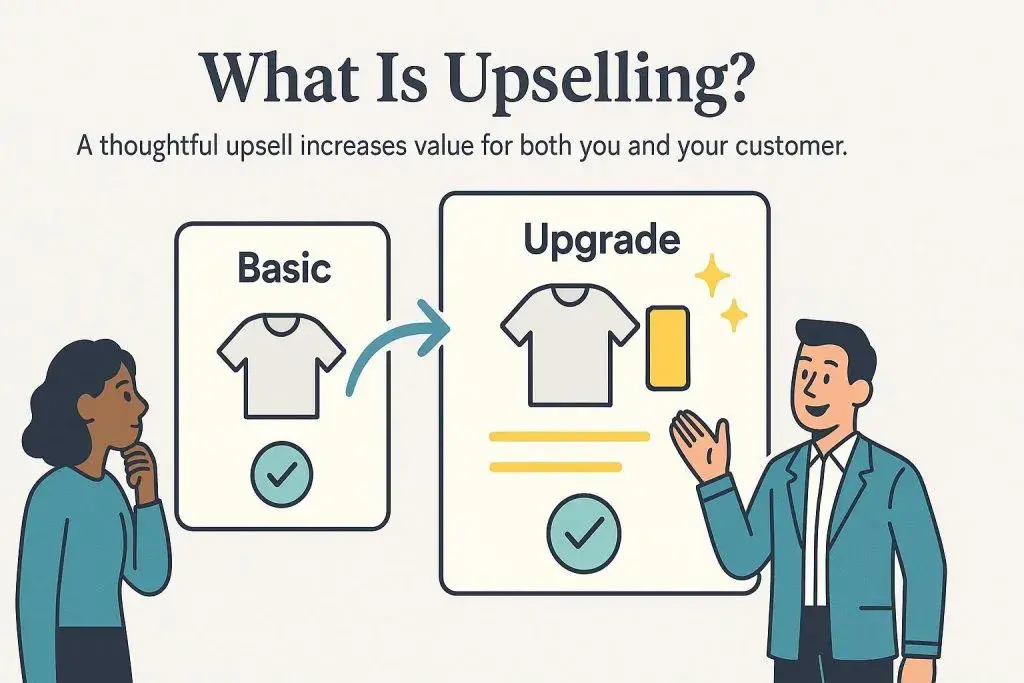
​Before we get into the best tips for upselling and cross-selling, let’s clarify the definitions of each. Upselling is a sales technique in which a salesperson entices customers to purchase more-expensive items or upgrades to make a more profitable sale. Sales professionals who master this technique can impact their company’s bottom line while enhancing customer satisfaction. 

Upselling gives you a great return on your investment. You’ve already invested the time to make the initial sale. It’s much easier to upsell than to make the primary sale, and the upsell is much more likely to be successful. The customer has already decided to trust your recommendation with the first purchase. With that credibility, it’s easier to sell more to them.

When done correctly, upselling increases customer satisfaction. Customers want value and are often willing to spend more money to get a better value.

However, the way you upsell is key. If the sale is framed as wanting the customer to get the most for their money, upselling makes the client feel valued. If the customer senses you are attempting to increase your bottom line, they will feel used, which could lead to the loss of the customer or a decline in sales.

What is cross-selling?
Picture
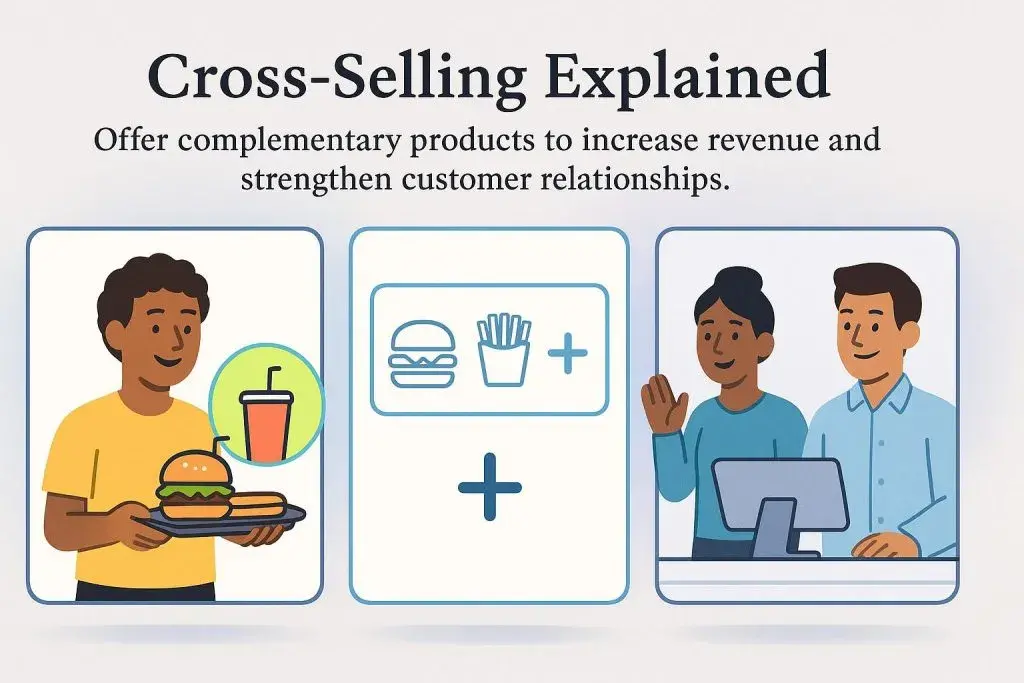
​Cross-selling involves selling additional products and services to an existing customer based on their initial purchase. The products or services involved in cross-selling complement what the customer already bought.

For example, a fast-food restaurant famously asks, “Would you like fries with that?” The customer orders a burger and a soft drink, which allows the clerk to sell them an additional product, fries, to complete their order and satisfy the customer’s needs while increasing the purchase amount for the business.

This sales method can boost revenue up to 30 percent according to McKinsey research, while also strengthening customer relationships. Due to the complementary nature of the products or services offered in a cross-sale, the technique can be highly effective. Once you know your customers and have formed a relationship with them, it’s much easier to make recommendations, offer discounts on certain products, or put together bundles that could save them money.

Bottom Line
When cross-selling to customers, you want to address and satisfy their needs. It’s more beneficial to cross-sell once you have established an initial relationship and know their desires well.

How do upselling and cross-selling work?
Picture
​Though the two are different, upselling and cross-selling benefit both customers and businesses. Both strategies encourage customers to spend more money, thereby increasing your revenue and providing greater value to customers. Combining the two strategies informs customers of options, packages and products they may be unaware of or didn’t think were necessary at the time.

Consider a customer shopping for a new laptop. To upsell, the salesperson might recommend a model with more RAM and a faster processor for better performance. To cross-sell, they could suggest adding a wireless mouse, laptop bag and extended warranty protection plan.

As this example shows, these selling styles can complement each other. But for either technique to work, it is crucial to know your customers and understand their desires and needs so you can make appropriate recommendations that don’t come off as a money grab.

FYI
Your goal should be to respond to customers’ needs with complementary or superior products and services.
Tips for upselling and cross-selling
Picture
​When you’re upselling and cross-selling, it’s important to maintain customers’ trust and demonstrate that you value their business. Keep the following tips in mind to ensure your strategies are effective.

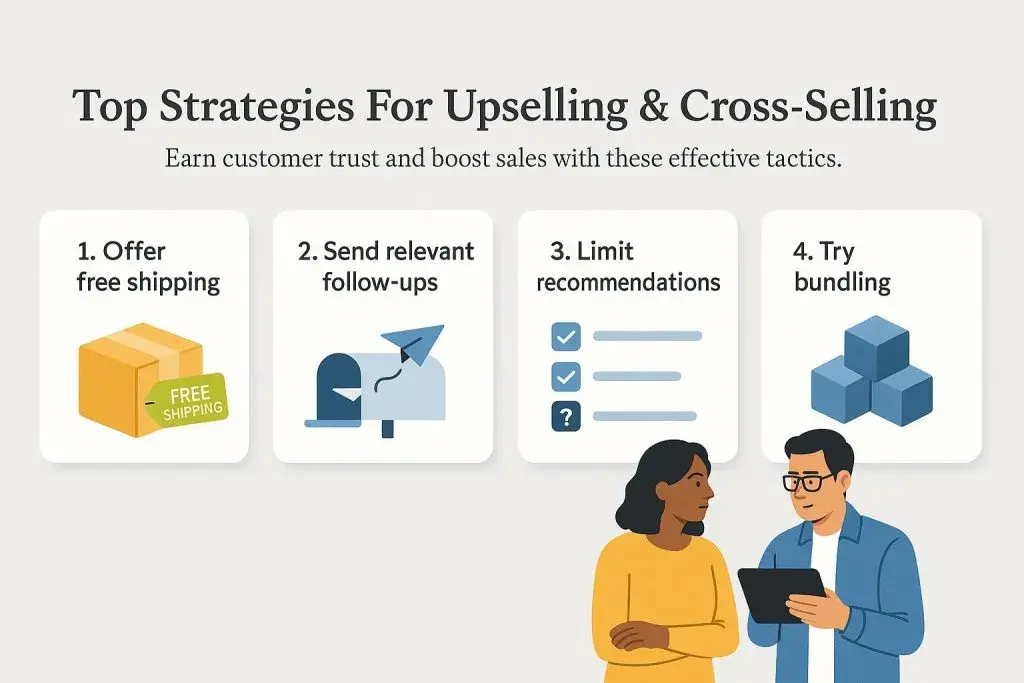
1. Offer free shipping.

Research from PYMNTS shows that 66 percent of consumers consider free shipping when choosing an online vendor. Online retailers can include shipping in the total product price to give the appearance that shipping is free, or they can choose to set a minimum purchase total that rewards customers with free shipping. Another way to offer free shipping is by encouraging customers to purchase subscriptions or join a loyalty program.

2. Send follow-up emails.

Customers want brands to engage with them and form a deep connection, as long as the communications are relevant and beneficial. Follow-up emails are a great way to welcome clients to your business, thank them for shopping, ask for customer feedback on products or remind them to check back in after cart abandonment. However, sending emails at strategic times is key to their effectiveness.

Send communications promptly after customers’ interactions, such as when they browse specific items. This helps confirm their interest in your product or service, allowing you to send targeted messages that drive customers toward purchases. Automation can streamline your follow-up process by automatically triggering personalized emails or notifications based on customer actions. This saves time and resources by facilitating the follow-up process without human intervention.

3. Limit recommendations.

When upselling, more options do not necessarily increase the chances of a sale. Remember that more choices usually generate more confusion and overwhelm consumers. Successful upsells begin with a solution to customers’ problems — not more questions.

When you give cross-selling recommendations, offer only a few options rather than dozens. A few well-targeted suggestions will maximize your shot at a successful sale. For instance, when customers purchase software subscriptions, successful companies typically limit their add-on suggestions to three complementary services such as cloud storage, priority support or training packages to avoid decision fatigue.

4. Try bundling.

Bundling encourages both upselling and cross-selling, so it’s smart to package related items together. For example, you can sell WordPress templates, plug-ins and logos in bundles of various combinations instead of offering them only as stand-alone items. The chances that a consumer will purchase all three of these items increase dramatically if they can do so with a single purchase instead of three separate purchases. Therefore, bundling can boost your company’s revenue.

Tip
Another great strategy for successful cross-selling is to provide a range of prices for items that work well together.

5. Know your customers.

Mapping the customer journey with comprehensive audience research is essential for successful upselling and cross-selling. Make sure you know your customers and understand their wants, needs and preferences so your attempts at offering upgrades or additional products seem like natural extensions of the main product.

For example, an effective server in a high-end restaurant knows to pay attention to the preferences and tastes of regular customers. If the same couple comes in several times a month and always orders the same bottle of Malbec, the server should take note of this and eventually recommend a more expensive bottle suited to the customers’ taste. This move would likely impress the diners and boost the restaurant’s revenue. This upselling method communicates that you have the customers’ best interests in mind.

Modern e-commerce platforms use sophisticated algorithms to track customer behavior and purchase history. For instance, Amazon effectively upsells and cross-sells based on its knowledge of customers. The company tracks customers’ orders and makes purchase recommendations based on past orders. If you have ever bought a book from Amazon, you have probably noticed that the company logs your book orders and suggests other relevant reading material based on what shoppers with similar taste purchased.

6. Keep the 25-percent rule in mind.

As a general rule, never try to upsell or cross-sell items that cost over 25 percent more than the original order. So, if a potential car buyer walks onto a dealer’s lot intending to purchase a Honda, the salesperson probably shouldn’t try to upsell the buyer with a Porsche. By sticking to the 25-percent rule, you will avoid making outlandish customer suggestions and boost your odds of closing sales.

The same principle applies to cross-selling. If a customer purchases a $200 smartwatch, appropriate cross-sell items might include a $30 protective case, $40 extra bands or a $50 wireless charging stand — all falling within the 25 percent threshold.

7. Be transparent about pricing.

To upsell or cross-sell effectively, share prices upfront and include breakdowns when possible. Customers aren’t interested in tracking down pricing information on products they didn’t request. However, presenting the pricing upfront and emphasizing the value to customers can easily sway them into adding one more product to their cart.

Partner transparency with strategy when you’re upselling or cross-selling. Set a maximum price margin — ideally no higher than 50 percent of the original purchase total — and recommend relevant products and services, even if they fall below this margin. This prevents your upselling or cross-selling tactics from appearing greedy.

8. Set a limited time for offers.

Offering limited-time deals to customers is a great way to encourage fast decision-making and higher-value purchases. For example, you could offer a multiday sale to clear out last season’s inventory or a surprise promotional discount that expires in hours. 

Short-term deals emphasize the small window customers have to make a purchase. This can convince undecided customers to buy, particularly if their hesitation was due to price. A special offer can make customers perceive the product or service as a better value. Plus, it builds a sense of urgency because they might lose out on a deal if they don’t act quickly.

9. Pitch add-ons by demonstrating the use case with the current purchase.

Give concrete examples of how the suggested product or service can benefit the customers’ current purchase. Doing so demonstrates the value of purchasing this add-on and helps persuade customers to move forward.

Demonstrating use cases presents a great opportunity to bolster your online presence, too. Create video content showing products working together, develop comparison charts highlighting compatibility and feature customer testimonials that mention successful product combinations. On your website, capitalize on your social proof by highlighting customers’ ratings. For example, display products and services that are most liked by customers, and suggest items that are frequently bought together based on past customer behavior.

Did You Know?
Customers face many decisions throughout the day, often resulting in decision fatigue. The decoy effect exploits this decision fatigue to deliver an option that appears to have a greater value, thus capitalizing on consumers' tendency to compare products on factors such as cost and features.

10. Leverage comparative offers.

Use comparative offers to show the value of your product or service. For example, you can display side-by-side comparisons demonstrating the customer’s current benefits versus the potential benefits from the upsell or cross-sell. The language you use when creating these comparisons is key to their effectiveness. So include persuasive words, and consider playing on customers’ concerns about missing out on deals.

Some businesses take comparative offers a step further by attempting the decoy effect. This strategy introduces product or service options that are priced strategically and filled with features to make certain options — generally, higher-priced ones — appear more valuable and appealing. When used correctly, this strategy drives customers’ decision-making by creating a perceived value that leads them to choose the more expensive options.

Jerry Low contributed to the reporting and writing in this article.

Want more ideas you can put to work with your team?

Explore more practical sales insights →

Thinking about strengthening your B2B sales team? Learn more about our B2B sales training & coaching →

Written by: Sean Peek, Senior Analyst, Business.com

Sean Peek co-founded and self-funded a small business that's grown to include more than a dozen dedicated team members. Over the years, he's become adept at navigating the intricacies of bootstrapping a new business, overseeing day-to-day operations, utilizing process automation to increase efficiencies and cut costs, and leading a small workforce. This journey has afforded him a profound understanding of the B2B landscape and the critical challenges business owners face as they start and grow their enterprises today. At business.com, Peek covers technology solutions like document management, POS systems and email marketing services, along with topics like management theories and company culture. In addition to running his own business, Peek shares his first-hand experiences and vast knowledge to support fellow entrepreneurs, offering guidance on everything from business software to marketing strategies to HR management. In fact, his expertise has been featured in Entrepreneur, Inc. and Forbes and with the U.S. Chamber of Commerce.

Stay Connected

Monthly Sales Insights

Receive one practical sales insight each month to help your B2B team strengthen sales execution, improve pipeline quality and build forecast confidence.

One email each month. Unsubscribe anytime.

0 Comments
    Picture

    Paul Mason 
    Founder | Sales Trainer | Sales Coach

    Paul is the founder of Touchstone Training & Coaching and creator of the Q-RED™ Sales System. He works with Western Sydney B2B SMEs to build structured, repeatable sales conversations that improve pipeline discipline, forecast confidence, and conversion outcomes.

    With senior experience across publishing, media, HR, recruitment, and technology sectors throughout Australia and APAC 
    – and clients around the world – Paul brings practical commercial insight, not theory, to every article he writes.

    View my profile on LinkedIn

    Archives

    September 2026
    August 2026
    July 2026
    June 2026
    May 2026
    April 2026
    March 2026
    February 2026
    January 2026
    December 2025
    November 2025
    October 2025
    September 2025

    Schedule a Call

    Prefer email or a different time? Contact us and we’ll get back to you.

    Frequently Asked Questions →
    Complete the Health Check
    Explore the Diagnostic
    Explore Q-RED™ Foundations

    Explore our services

    Start with the system – then explore how we implement it:

    Q-RED™ Sales System Sales Training Sales Coaching

    Terms & Conditions | Privacy Policy | Terms of Use

© Touchstone Training & Coaching 2026 · Western Sydney, NSW · Q-RED™ Sales System · Sales Training · Sales Coaching

Serving Western Sydney commercial & industrial hubs: Parramatta · Macquarie Park · Norwest · Penrith · Liverpool · Eastern Creek · Wetherill Park · Smithfield · Erskine Park · Prestons · Ingleburn

  • Home
  • Q-RED™ Sales System
  • Training & Coaching
    • Sales Training
    • Sales Coaching
  • Industries
    • Manufacturing
    • Construction & Infrastructure
    • Engineering & Technical Services
    • Transport & Logistics
    • B2B Technology & Solution Sales
    • Professional Services
  • Resources
    • Sales Health Check
    • Sales Performance Diagnostic
    • Sales Insights
    • Sales Library
    • Q-RED™ Foundations
  • About
  • FAQs
  • Contact