
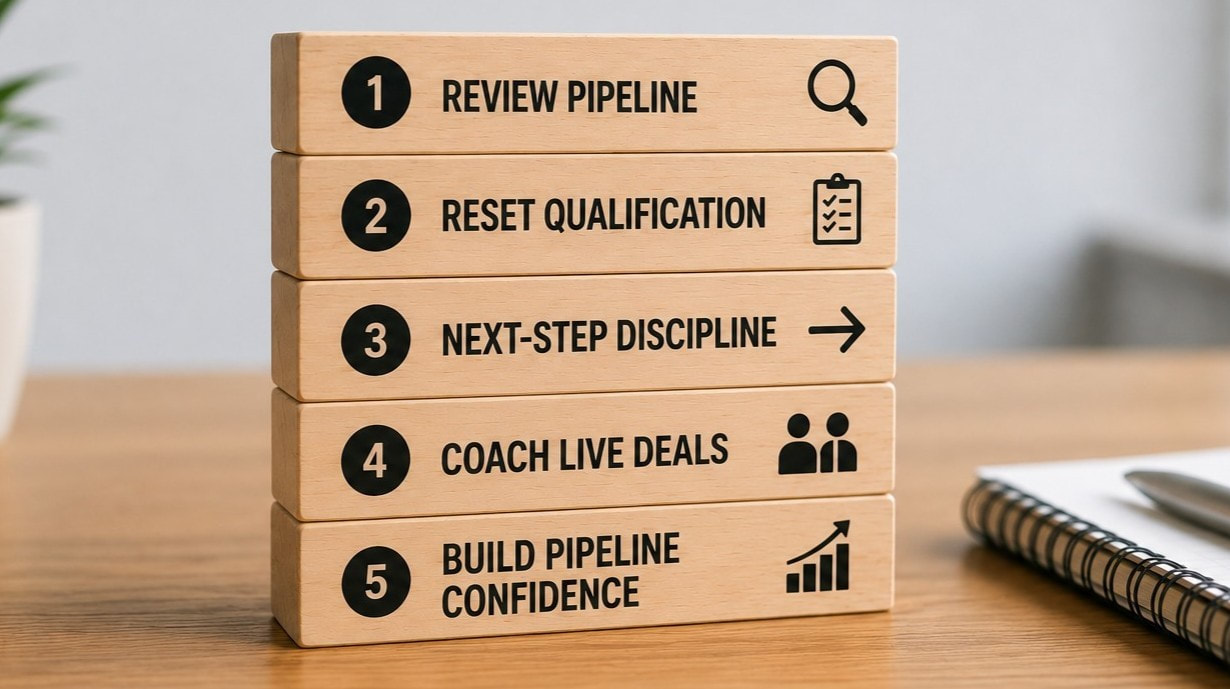
Just a week ago, many B2B sales teams were focused on closing business before 30 June. Now the pressure has changed. The start of FY27 brings renewed targets, updated budgets and fresh expectations. For many Australian businesses, July is a natural reset point. Sales plans are reviewed, revenue goals are refreshed, and teams begin the year with a renewed focus on growth. But while many organisations spend time setting targets, fewer spend enough time strengthening the sales disciplines that determine whether those targets are achieved. Last month, we explored how B2B sales teams can avoid unnecessary discounting during the EOFY rush. Now that the new financial year has begun, the focus shifts from protecting margin to strengthening the sales execution that creates more consistent commercial performance. The strongest sales teams do not rely on motivation alone. They rely on consistent execution. They qualify well, manage opportunities clearly, coach live deals, and build confidence in the pipeline before the quarter is under pressure. That is why the first 90 days of FY27 matter. They are not just the beginning of the year. They are an opportunity to reset the habits, standards and behaviours that shape commercial performance. Here are five practical sales disciplines that can help. 1. Review the Pipeline You Are Actually CarryingA healthy pipeline is not measured by the number of opportunities it contains. It is measured by the quality of those opportunities. Many sales teams begin the year with a pipeline that looks active, but not all opportunities carry the same commercial value. Some are progressing. Some are stalled. Others remain in the pipeline because no one has made the decision to remove them. This creates false confidence. If a pipeline contains too many low-probability opportunities, forecasts become less reliable and salespeople spend valuable time on deals that are unlikely to convert. Many pipelines also contain opportunities carried over from June. Rather than assuming they remain active, July is the ideal time to re-qualify those opportunities and decide whether they genuinely belong in the new financial year's forecast. At the start of FY27, sales leaders should ask:
Removing weak opportunities is not negative. It improves focus, strengthens pipeline visibility, and helps the team spend more time where there is genuine potential. 2. Reset Qualification Standards EarlyQualification discipline has a direct impact on sales productivity. When qualification is weak, teams spend too much time pursuing opportunities that were never likely to move forward. The result is longer sales cycles, weaker forecasts, and frustration for both salespeople and leaders. The start of the financial year is the right time to reset what a real opportunity looks like. Strong qualification is not about being difficult. It is about being clear. Does the customer have a genuine need? Is there a commercial reason to act? Is there authority to progress? Is the timing realistic? Is there enough value to justify the investment? Better qualification helps teams say “yes” to the right opportunities and “not yet” or “not suitable” to the wrong ones. Within the Q-RED™ Sales System, Qualification is the first stage for a reason. If the opportunity is not properly qualified, every later stage becomes harder to manage. 3. Strengthen Next-Step DisciplineMany opportunities do not stall because the customer has said no. They stall because the next step was never clear enough. A follow-up email is not always a next step. “Checking in next week” is rarely enough. A real next step should include a clear action, agreed ownership and a realistic timeframe. For example:
Clear next steps create movement. Unclear next steps create drift. This is especially important in B2B sales where decisions often involve multiple people, competing priorities and changing timelines. Within Q-RED™, this connects strongly to the Decision stage. The objective is not simply to keep following up. The objective is to create decision clarity so both the salesperson and customer understand what progress actually looks like. 4. Coach Live Opportunities, Not Just ActivitySales meetings often focus heavily on activity and numbers. How many calls were made? How many meetings were booked? What is closing this month? These are important questions, but they do not always improve the quality of the opportunity. Effective coaching goes deeper. It helps salespeople think through live deals, challenge assumptions, understand customer requirements, strengthen evidence and clarify the path to decision. Coaching is not simply telling people what to do. It is asking the right questions so they can improve their own judgement and apply better sales discipline in real situations. This is where training and coaching work best together. Sales training builds understanding. Sales coaching helps embed the behaviour through live opportunities. Without reinforcement, even good training can lose momentum. With consistent coaching, new disciplines are more likely to become part of how the team sells every day. 5. Measure Forecast Confidence, Not Just RevenueRevenue is important, but it is a lagging indicator. By the time revenue is missed, the issues that caused the gap often appeared much earlier in the pipeline. That is why sales leaders should measure the behaviours and signals that create forecast confidence. These may include:
When these areas improve, forecasting usually becomes clearer because the pipeline is based on better information. The objective is not to create more reports. It is to create better visibility. This is where the full Q-RED™ framework becomes valuable. Qualification improves deal quality. Requirements clarify the commercial problem. Evidence builds confidence. Decision discipline creates clearer movement through the pipeline. Sales leaders do not need perfect certainty. They need enough confidence to make better decisions about resources, priorities, coaching and growth. Building More Consistent Sales Performance in FY27The start of a new financial year is not just an opportunity to reset sales targets. It is an opportunity to reset the disciplines that determine whether those targets are achieved. Many businesses already have capable sales teams. The opportunity is not always to start again. It is often to create greater consistency in the way the team qualifies opportunities, progresses deals, coaches performance and manages the pipeline. The goal is rarely to change everything. More often, it is to introduce greater consistency into the way sales opportunities are qualified, progressed, coached and forecast. That consistency can reduce wasted effort, improve deal control, strengthen pipeline visibility and create greater confidence in the year ahead. This is where a structured sales system can make a significant difference. At Touchstone, we help B2B teams selling into SME markets strengthen sales execution through the structured, sequential Q-RED™ Sales System. Delivered through practical workplace training and reinforced with live-deal coaching, Q-RED™ helps teams improve qualification discipline, strengthen deal control, increase pipeline visibility and build greater forecast confidence. The objective is not simply to deliver training. It is to help sales teams develop disciplines that become part of the way they work every day. Explore Q-RED™ Foundations A practical starting point for B2B teams selling into SME markets Q-RED™ Foundations introduces your team to the structured, sequential Q-RED™ Sales System through practical training, discussion, role-play and live-deal application. It gives your team a common language and framework before deeper coaching embeds the behaviours in real opportunities. You can also explore Touchstone’s Sales Health Check, sales training, sales coaching, or learn more about the Q-RED™ Sales System. Structured Sales. Human Delivery. Stay Connected Monthly Sales InsightsReceive one practical sales insight each month to help your B2B team strengthen sales execution, improve pipeline quality and build forecast confidence. One email each month. Unsubscribe anytime.
0 Comments
Leave a Reply. |

Paul Mason
|

© Touchstone Training & Coaching 2026 · Western Sydney, NSW · Q-RED™ Sales System · Sales Training · Sales Coaching
Serving Western Sydney commercial & industrial hubs: Parramatta · Macquarie Park · Norwest · Penrith · Liverpool · Eastern Creek · Wetherill Park · Smithfield · Erskine Park · Prestons · Ingleburn