
Touchstone Training & Coaching
  • Home
  • Industries
    • Manufacturing
    • Construction & Infrastructure
    • Engineering & Technical Services
    • Transport & Logistics
    • B2B Technology & Solution Sales
    • Professional Services
  • Programs
    • Q-RED™ Sales Sprints
    • Industry Sales Training Day
    • Q-RED™ Foundations
    • Industry Sales Coaching
    • Coaching for Managers
  • About
  • Q-RED™ Sales System
  • Training & Coaching
    • Sales Training
    • Sales Coaching
  • Resources
    • Sales Health Check
    • Sales Performance Diagnostic
    • Sales Insights
    • Sales Library
  • FAQs
  • Contact

Stronger Sales, Better Results: Why Sales Training & Coaching Matters for Western Sydney SMEs

10/11/2025

0 Comments

 
Picture

Running a small or medium-sized business in Western Sydney comes with big challenges. You’re juggling operations, staff, and customers – while trying to grow revenue in a competitive market.

That’s why more and more business owners are turning to independent sales training and sales coaching to give their teams an edge.


Why Sales Training Matters

In today’s market, the way people buy has changed. Customers are more informed, competition is stronger, and price pressure is constant. For SMEs, having a capable, confident sales team isn’t a luxury – it’s essential.

A structured sales training and coaching program helps your team:

  • Build stronger customer relationships
  • Ask better discovery questions
  • Confidently handle objections and pricing conversations
  • Consistently close more deals

In short, training turns “good” salespeople into great ones.


The Value of an Outside Perspective

Many SME owners try to handle sales development internally – but it’s hard to train and coach effectively when you’re running the business.

That’s where a third-party sales training provider adds real value:

  • Fresh perspective: An external coach spots blind spots and missed opportunities.
  • Proven frameworks: Access tested sales processes that actually work in the field.
  • Accountability: Ongoing coaching ensures new skills are applied – not forgotten.
  • Team alignment: Your sales team works together with a shared language and process.

Independent support keeps your team motivated, consistent, and results-focused.


Designed for Western Sydney Businesses

A good training partner understands the Western Sydney business landscape – from manufacturing and professional services to construction and technology.

That local understanding means the content is practical, relevant, and tailored to the challenges you face every day.


The Results Speak for Themselves

When you strengthen sales capability, you’ll see measurable results:

  • Higher conversion rates
  • Increased deal values
  • Better customer retention
  • A stronger, more confident team culture

Many SMEs experience 200%+ ROI on their sales training and coaching investment within months.


Final Thought

If you want your Western Sydney SME to grow sustainably, your sales team needs the right skills, systems, and support. Partnering with a third-party sales training and coaching provider gives you exactly that – a clear path to stronger performance and long-term success.


Stronger Sales, Better Results for Western Sydney SMEs

If you’re considering external support for your sales team, you can explore our B2B sales training, sales coaching, and Q-RED™ Sales System options, or visit Touchstone Training & Coaching to get in touch and discuss what’s right for your team.

Want more ideas you can put to work with your team?

Explore more practical sales insights →

Stay Connected

Monthly Sales Insights

Receive one practical sales insight each month to help your B2B team strengthen sales execution, improve pipeline quality and build forecast confidence.

One email each month. Unsubscribe anytime.

0 Comments

Super Sales Strategies: Quick Tips for Upselling and Cross-Selling

3/11/2025

0 Comments

 
Picture
Congratulations; you’ve made a sale! But in reality, the battle has just begun. What comes after you’ve made that sale? Hopefully, more sales. That’s where upselling and cross-selling come into play. These popular sales techniques help drive more sales from converted customers, who are easier to sell to.

What is upselling?
Picture
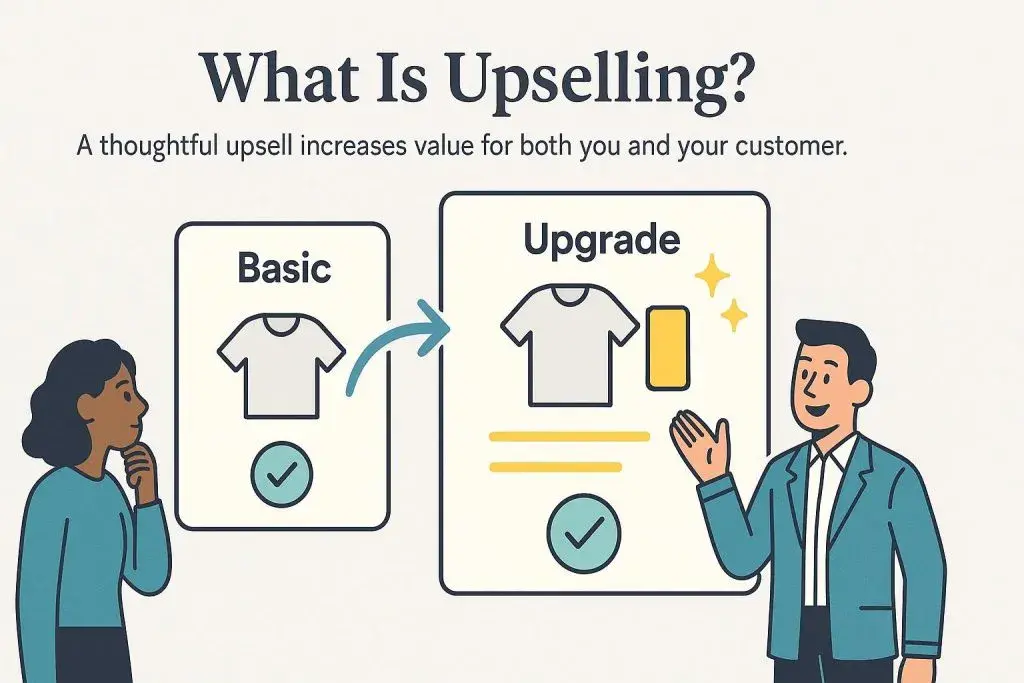
​Before we get into the best tips for upselling and cross-selling, let’s clarify the definitions of each. Upselling is a sales technique in which a salesperson entices customers to purchase more-expensive items or upgrades to make a more profitable sale. Sales professionals who master this technique can impact their company’s bottom line while enhancing customer satisfaction. 

Upselling gives you a great return on your investment. You’ve already invested the time to make the initial sale. It’s much easier to upsell than to make the primary sale, and the upsell is much more likely to be successful. The customer has already decided to trust your recommendation with the first purchase. With that credibility, it’s easier to sell more to them.

When done correctly, upselling increases customer satisfaction. Customers want value and are often willing to spend more money to get a better value.

However, the way you upsell is key. If the sale is framed as wanting the customer to get the most for their money, upselling makes the client feel valued. If the customer senses you are attempting to increase your bottom line, they will feel used, which could lead to the loss of the customer or a decline in sales.

What is cross-selling?
Picture
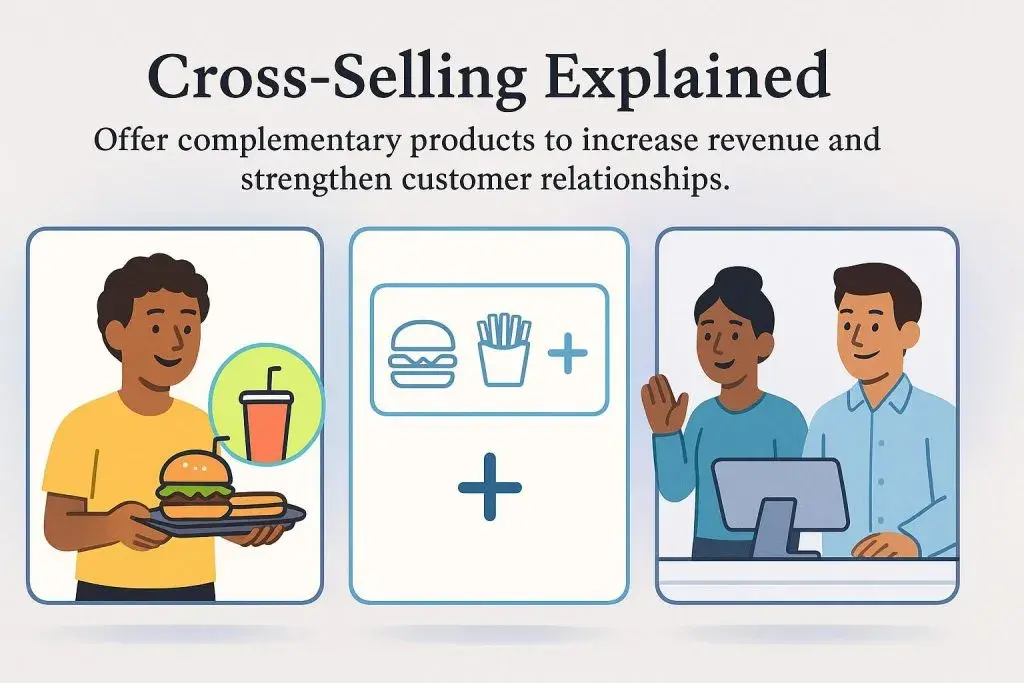
​Cross-selling involves selling additional products and services to an existing customer based on their initial purchase. The products or services involved in cross-selling complement what the customer already bought.

For example, a fast-food restaurant famously asks, “Would you like fries with that?” The customer orders a burger and a soft drink, which allows the clerk to sell them an additional product, fries, to complete their order and satisfy the customer’s needs while increasing the purchase amount for the business.

This sales method can boost revenue up to 30 percent according to McKinsey research, while also strengthening customer relationships. Due to the complementary nature of the products or services offered in a cross-sale, the technique can be highly effective. Once you know your customers and have formed a relationship with them, it’s much easier to make recommendations, offer discounts on certain products, or put together bundles that could save them money.

Bottom Line
When cross-selling to customers, you want to address and satisfy their needs. It’s more beneficial to cross-sell once you have established an initial relationship and know their desires well.

How do upselling and cross-selling work?
Picture
​Though the two are different, upselling and cross-selling benefit both customers and businesses. Both strategies encourage customers to spend more money, thereby increasing your revenue and providing greater value to customers. Combining the two strategies informs customers of options, packages and products they may be unaware of or didn’t think were necessary at the time.

Consider a customer shopping for a new laptop. To upsell, the salesperson might recommend a model with more RAM and a faster processor for better performance. To cross-sell, they could suggest adding a wireless mouse, laptop bag and extended warranty protection plan.

As this example shows, these selling styles can complement each other. But for either technique to work, it is crucial to know your customers and understand their desires and needs so you can make appropriate recommendations that don’t come off as a money grab.

FYI
Your goal should be to respond to customers’ needs with complementary or superior products and services.
Tips for upselling and cross-selling
Picture
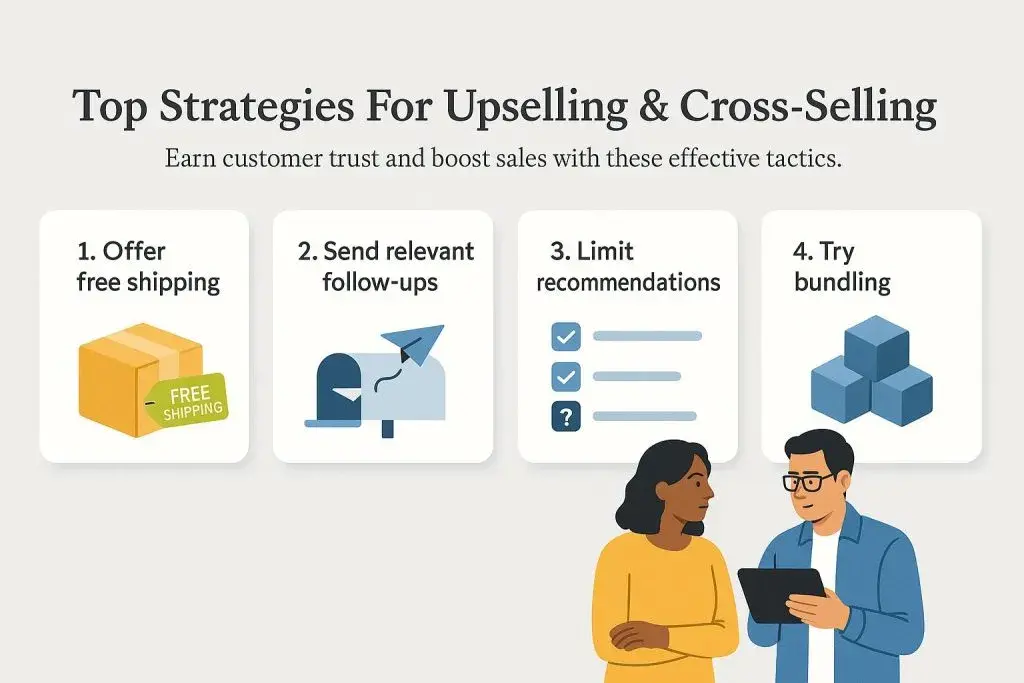
​When you’re upselling and cross-selling, it’s important to maintain customers’ trust and demonstrate that you value their business. Keep the following tips in mind to ensure your strategies are effective.

1. Offer free shipping.

Research from PYMNTS shows that 66 percent of consumers consider free shipping when choosing an online vendor. Online retailers can include shipping in the total product price to give the appearance that shipping is free, or they can choose to set a minimum purchase total that rewards customers with free shipping. Another way to offer free shipping is by encouraging customers to purchase subscriptions or join a loyalty program.

2. Send follow-up emails.

Customers want brands to engage with them and form a deep connection, as long as the communications are relevant and beneficial. Follow-up emails are a great way to welcome clients to your business, thank them for shopping, ask for customer feedback on products or remind them to check back in after cart abandonment. However, sending emails at strategic times is key to their effectiveness.

Send communications promptly after customers’ interactions, such as when they browse specific items. This helps confirm their interest in your product or service, allowing you to send targeted messages that drive customers toward purchases. Automation can streamline your follow-up process by automatically triggering personalized emails or notifications based on customer actions. This saves time and resources by facilitating the follow-up process without human intervention.

3. Limit recommendations.

When upselling, more options do not necessarily increase the chances of a sale. Remember that more choices usually generate more confusion and overwhelm consumers. Successful upsells begin with a solution to customers’ problems — not more questions.

When you give cross-selling recommendations, offer only a few options rather than dozens. A few well-targeted suggestions will maximize your shot at a successful sale. For instance, when customers purchase software subscriptions, successful companies typically limit their add-on suggestions to three complementary services such as cloud storage, priority support or training packages to avoid decision fatigue.

4. Try bundling.

Bundling encourages both upselling and cross-selling, so it’s smart to package related items together. For example, you can sell WordPress templates, plug-ins and logos in bundles of various combinations instead of offering them only as stand-alone items. The chances that a consumer will purchase all three of these items increase dramatically if they can do so with a single purchase instead of three separate purchases. Therefore, bundling can boost your company’s revenue.

Tip
Another great strategy for successful cross-selling is to provide a range of prices for items that work well together.

5. Know your customers.

Mapping the customer journey with comprehensive audience research is essential for successful upselling and cross-selling. Make sure you know your customers and understand their wants, needs and preferences so your attempts at offering upgrades or additional products seem like natural extensions of the main product.

For example, an effective server in a high-end restaurant knows to pay attention to the preferences and tastes of regular customers. If the same couple comes in several times a month and always orders the same bottle of Malbec, the server should take note of this and eventually recommend a more expensive bottle suited to the customers’ taste. This move would likely impress the diners and boost the restaurant’s revenue. This upselling method communicates that you have the customers’ best interests in mind.

Modern e-commerce platforms use sophisticated algorithms to track customer behavior and purchase history. For instance, Amazon effectively upsells and cross-sells based on its knowledge of customers. The company tracks customers’ orders and makes purchase recommendations based on past orders. If you have ever bought a book from Amazon, you have probably noticed that the company logs your book orders and suggests other relevant reading material based on what shoppers with similar taste purchased.

6. Keep the 25-percent rule in mind.

As a general rule, never try to upsell or cross-sell items that cost over 25 percent more than the original order. So, if a potential car buyer walks onto a dealer’s lot intending to purchase a Honda, the salesperson probably shouldn’t try to upsell the buyer with a Porsche. By sticking to the 25-percent rule, you will avoid making outlandish customer suggestions and boost your odds of closing sales.

The same principle applies to cross-selling. If a customer purchases a $200 smartwatch, appropriate cross-sell items might include a $30 protective case, $40 extra bands or a $50 wireless charging stand — all falling within the 25 percent threshold.

7. Be transparent about pricing.

To upsell or cross-sell effectively, share prices upfront and include breakdowns when possible. Customers aren’t interested in tracking down pricing information on products they didn’t request. However, presenting the pricing upfront and emphasizing the value to customers can easily sway them into adding one more product to their cart.

Partner transparency with strategy when you’re upselling or cross-selling. Set a maximum price margin — ideally no higher than 50 percent of the original purchase total — and recommend relevant products and services, even if they fall below this margin. This prevents your upselling or cross-selling tactics from appearing greedy.

8. Set a limited time for offers.

Offering limited-time deals to customers is a great way to encourage fast decision-making and higher-value purchases. For example, you could offer a multiday sale to clear out last season’s inventory or a surprise promotional discount that expires in hours. 

Short-term deals emphasize the small window customers have to make a purchase. This can convince undecided customers to buy, particularly if their hesitation was due to price. A special offer can make customers perceive the product or service as a better value. Plus, it builds a sense of urgency because they might lose out on a deal if they don’t act quickly.

9. Pitch add-ons by demonstrating the use case with the current purchase.

Give concrete examples of how the suggested product or service can benefit the customers’ current purchase. Doing so demonstrates the value of purchasing this add-on and helps persuade customers to move forward.

Demonstrating use cases presents a great opportunity to bolster your online presence, too. Create video content showing products working together, develop comparison charts highlighting compatibility and feature customer testimonials that mention successful product combinations. On your website, capitalize on your social proof by highlighting customers’ ratings. For example, display products and services that are most liked by customers, and suggest items that are frequently bought together based on past customer behavior.

Did You Know?
Customers face many decisions throughout the day, often resulting in decision fatigue. The decoy effect exploits this decision fatigue to deliver an option that appears to have a greater value, thus capitalizing on consumers' tendency to compare products on factors such as cost and features.

10. Leverage comparative offers.

Use comparative offers to show the value of your product or service. For example, you can display side-by-side comparisons demonstrating the customer’s current benefits versus the potential benefits from the upsell or cross-sell. The language you use when creating these comparisons is key to their effectiveness. So include persuasive words, and consider playing on customers’ concerns about missing out on deals.

Some businesses take comparative offers a step further by attempting the decoy effect. This strategy introduces product or service options that are priced strategically and filled with features to make certain options — generally, higher-priced ones — appear more valuable and appealing. When used correctly, this strategy drives customers’ decision-making by creating a perceived value that leads them to choose the more expensive options.

Jerry Low contributed to the reporting and writing in this article.

Want more ideas you can put to work with your team?

Explore more practical sales insights →

Thinking about strengthening your B2B sales team? Learn more about our B2B sales training & coaching →

Written by: Sean Peek, Senior Analyst, Business.com

Sean Peek co-founded and self-funded a small business that's grown to include more than a dozen dedicated team members. Over the years, he's become adept at navigating the intricacies of bootstrapping a new business, overseeing day-to-day operations, utilizing process automation to increase efficiencies and cut costs, and leading a small workforce. This journey has afforded him a profound understanding of the B2B landscape and the critical challenges business owners face as they start and grow their enterprises today. At business.com, Peek covers technology solutions like document management, POS systems and email marketing services, along with topics like management theories and company culture. In addition to running his own business, Peek shares his first-hand experiences and vast knowledge to support fellow entrepreneurs, offering guidance on everything from business software to marketing strategies to HR management. In fact, his expertise has been featured in Entrepreneur, Inc. and Forbes and with the U.S. Chamber of Commerce.

Stay Connected

Monthly Sales Insights

Receive one practical sales insight each month to help your B2B team strengthen sales execution, improve pipeline quality and build forecast confidence.

One email each month. Unsubscribe anytime.

0 Comments

Sell Yourself: 7 Secrets to Appearing Confident During a Sales Pitch

27/10/2025

0 Comments

 
Picture
For some people, confidence isn’t something that comes easily. We have provided the following steps to help foster confidence in sales.

​Pitching a sale can occur anywhere, be it from your office, during a business meeting, over a casual meal out or even through a virtual Zoom call. Confidence is a crucial factor that can decide if you secure a deal or lose it, regardless of whether it’s a one-on-one discussion or a group presentation. 

A sales pitch often serves as your business’s initial contact with a potential customer. It can be highly beneficial to research your client in advance to quickly address their worries. Seize this chance to not only promote your business beyond what your website or marketing emails say but also to educate them further. 

The most effective pitches are the ones that solve an issue for your client. It’s crucial to express that your product or service clearly is the ultimate solution by answering their questions and understanding their business needs. 

How to appear confident during a sales pitch

If you’ve noticed that your sales pitches are falling flat, check out our seven top tips for upselling and cross-selling. Find out if your go-to moves are turning off clients and how to make corrections so you can close the sale.

1. Practice your performance.

Practicing consistently brings about a sense of familiarity and comfort. Whether you’re getting ready for your very first public performance, planning to propose to a loved one or advocating for additional vacation days at work, regular practice makes these tasks more manageable. There’s wisdom in the saying “Practice makes perfect.” Even if perfection isn’t your goal, practicing regularly will undoubtedly improve your skills. 

Since humans first roamed the Earth, practicing a skill or task has been vital for survival, mastering a craft, promoting oneself and earning a livelihood. Exceptional communication skills aren’t innate for most of us, they’re learned over time. The key to this learning is practice. If you want to come across as confident during business pitches, you need to practice continuously.  

It’s crucial to remember that practice involves making mistakes. Practice isn’t about achieving perfection — it’s about improvement and growth, which often involves failing and learning from those failures. When you’re delivering business pitches, allow yourself the space to stumble. There’s a certain authenticity and sincerity in acknowledging our human flaws, traits that can make your pitches more appealing. Remember to be kind to yourself when you make mistakes and utilize these instances as learning opportunities. At the end of the day, remember that practice might not make perfect, but it surely brings us closer to it. 

2. Be persistent in your request.

Staying determined is a crucial aspect of conveying confidence during a sales conversation. By being steady and resolved, you display your commitment and resilience, showing you’re not someone who backs out easily. You’re motivated and prepared to do whatever it takes to bring about results. Even if sometimes, you have to fake your determination, it’s still a worthy quality as long as it’s not too forceful. 

React to your client’s responses with supporting data and queries to show how valuable your product is. Promote it with confidence. Persistence can be a powerful tool to satisfy your desires by assisting others in achieving theirs. The essential aspect here is to help your potential clients recognize their needs by providing them with insights. 

Assure them of the need for your product and explain its benefits. Be relentless in your approach ─ ask questions, share facts, maintain eye contact, offer helpful information and demonstrate personalized care. These will all help you in building a trustworthy relationship.  

3. Show pride in your products and services.

Being proud of the products you sell is a serious factor in confidence. If you believe in what you are trying to sell and stand behind every word of your sales pitch, you are more likely to make others feel the same. People are people, regardless of your products, and they have some of the best nonsense detectors built into them. How do you expect them to gain interest if you are faking your way through your sales pitch because you are disinterested?

4. Smile throughout the presentation.

Remember, a smile can make the difference in making your business welcoming. Keep a balance between professionalism and being approachable. Nobody wants to purchase from a business where the owner seems uninterested. Potential customers are more likely to engage with you if they feel they are talking with a real person, not just another business owner. 

True, your income depends on the sales you make but don’t let that become your reason to push a sale haphazardly. 

When communicating, be alive with expressions. Even if it feels exaggerated, hand gestures, wide-eyed enthusiasm and animated discussions bring a vibrant, positive energy to a conversation. Speaking to someone while standing still, maintaining a rigid expression, is not the best way to demonstrate your confidence while pitching your products. 

It’s true. Everyone knows whether you make a sale has a direct effect on how much money you take home that day, but that cannot be your continual excuse to fudge your way through sale after sale.

Bottom Line - Technology should enhance communication. Use a good microphone and camera on your computer to ensure you are seen and heard effectively.

5. Keep your body language confident.

Pay attention to your body language during a sales pitch. According to Shapiro Negotiations, “The best sales negotiators are the people who listen effectively.” By listening, we mean more than just words. What your body says ─ and especially what your client’s body is saying ─ should be an indicator for your next step. For example, did your customer raise their eyebrows at a particular comment you made or lift their chin? These are signs of interest and you’ve got their attention.

Beyond just the body language, ensure you are tuning into any verbal cues. Your ability to identify their interest or disinterest and respond effectively shows you are both prepared and confident. Additionally, it will give your client a chance to trust you, which is typically one of the first and most important steps in making a sale.

FYI - Role-play with your sales force to practice good sales habits and techniques.

6. Use storytelling to sell.

Storytelling is essential for connecting with your audience. Stories have a beginning, middle and end. Whether we are reading or watching them, a good story engages our attention in its entirety.

Storytelling can help the client identify pain points, failures and successes. Clients will “lean in” as you convey relatable characters and situations. Then, you finish with an arc that offers a must-have solution.

Researching clients before each pitch can also help you personalize the story. For example, include people in their inner circle, a challenge they had to work through or how their success story could look by using your product or service.
​
Did You Know? A consultative selling approach builds a relationship with the client's presales pitch by listening to their needs and gaining trust. After creating a connection, the salesperson personalizes a product or service. Consultative selling puts the client's needs above the sale and garners authentic business relationships.

7. Highlight your uniqueness.

Business leaders frequently listen to a variety of sales pitches. You must stand out from the crowd if you want them to listen to your pitch.

Engage emotionally with your customer, whether through humour or empathy, to help break the ice.

Try using the 60-second method. Craft a concise elevator pitch that provides a sales pitch overview. Then, pause for a moment to gauge their interest. Pausing can help calm nerves, keep you focused on the end goal and allow client interaction.

Tips for perfecting your sales pitch

Mastering the sales pitch involves understanding the product or service’s value, not just the product or service itself. Therefore, confidently communicating involves not only persuasiveness but also active listening.

If you are missing opportunities or lacking sales, check out the following sales pitch mistakes that could hinder your success.

Talk less, listen more.

You may believe getting every last detail of your sales pitch out is the most important goal, but finishing your pitch shouldn’t be your end game.

Most sales pitches fail because the speaker is doing all the talking and not listening. A failure to listen prevents connection ─ whether the meeting is in person or virtual.

Don’t plan your next move. Be present. A good salesperson is an active listener, so they can adapt to the client’s custom needs and provide solutions, not just noise.

Ditch the robot.

When presenting a sales pitch, put yourself in the client’s shoes. You only get one shot to make an excellent first impression. But, if they are learning about your company, product or service, do they need an in-depth presentation or a brief overview so they can ask questions?

Most of the time, engaging a client takes a conversation, not a presentation. Focus less on the details and more on active listening. The client is more likely to follow along if you include them in the presentation, rather than just talking at them.

Use storytelling to connect with your listeners; don’t overwhelm your customers with too many points. Be open to their questions during the pitch and be transparent with your answers. Trust is an integral part of sealing the deal.

Tip - Clients care less about the features of your product or service and more about the benefits. Don't bury this within your sales pitch or you'll lose your audience. Open with how your company can meet their needs so your client will see why you are so passionate.

Do your research.

It’s wise to research clients that you will be pitching to. Don’t waste time pitching to a client that doesn’t require your product or service.

The research applies to one-on-one pitches, virtual sales presentations and cold leads. First, do your homework to ensure your potential clients have a problem you can solve. Then, tailor your sales pitch to meet their needs.

Love your company. Love your client more.

Passion for your product or service is essential. However, no matter how much enthusiasm you put behind it, your ego can sometimes get in the way. When you put everything behind your product or service, you expect everyone else to do the same. But that won’t always happen. No one closes a sale 100 percent of the time ─ no matter what your product or service provides.

When a sales pitch doesn’t go your way, don’t blame the client for missing out on a once-in-a-lifetime opportunity. Instead, look at your product, service and sales pitch to see how you can improve.

Constructive criticism can be hard to swallow, but it will make you a better salesperson and help your company grow. Focus on the relationship. You may not always make a sale, but the ability to go back to the client when you have a new pitch is priceless.

Provide the next steps.

A sales pitch can’t be successful without a call to action (CTA). Unfortunately, while CTAs are prominent on landing pages, social media posts and email newsletters, inexperienced salespeople often forget that they must lead a conversation to the next step.

Once a client is interested in your pitch, clearly tell them what to do next. For example, whether they need to know how to contact you, access services directly or request a sample product, give the client the information at the end of the pitch. Providing the next steps keeps the client engaged and helps you follow up appropriately.

To have a successful business, you must learn to sell your product or service. You will constantly need new and repeat clients for your business to thrive. Mastering the sales pitch will help create your dream business. So be an active listener and encourage constructive criticism to improve and nurture more profound relationships. The more trust you can build with your clients, the easier it will be to engage them in a conversation that leads to a successful ─ and repeated ─ deal.

Kimberlee Leonard and Carol Evenson contributed to this article. 

Want more ideas you can put to work with your team?

Explore more practical sales insights →

Thinking about strengthening your B2B sales team? Learn more about our B2B sales training & coaching →

Written by: Julie Thompson, Senior Writer, Business.com

With nearly two decades of experience under her belt, Julie Thompson is a seasoned B2B professional dedicated to enhancing business performance through strategic sales, marketing and operational initiatives. Her extensive portfolio boasts achievements in crafting brand standards, devising innovative marketing strategies, driving successful email campaigns and orchestrating impactful media outreach. At business.com, Thompson covers branding, marketing, e-commerce and more. Thompson's expertise extends to Salesforce administration, database management and lead generation, reflecting her versatile skill set and hands-on approach to business enhancement. Through easily digestible guides, she demystifies complex topics such as SaaS technology, finance trends, HR practices and effective marketing and branding strategies. Moreover, Thompson's commitment to fostering global entrepreneurship is evident through her contributions to Kiva, an organization dedicated to supporting small businesses in underserved communities worldwide.

Stay Connected

Monthly Sales Insights

Receive one practical sales insight each month to help your B2B team strengthen sales execution, improve pipeline quality and build forecast confidence.

One email each month. Unsubscribe anytime.

0 Comments
<<Previous
Forward>>
    Picture
    Paul Mason
    Principal | Creator of the Q-RED™ Sales System
    Paul is the Principal Sales Trainer & Coach at Touchstone Training & Coaching. He works with B2B sales teams across Sydney and beyond, delivering system-aligned sales training and live-deal coaching to build capability, strengthen sales conversations and improve conversion outcomes.
    His senior commercial experience spans publishing, media, HR, recruitment and technology across Australia and APAC. Having also worked with clients around the world, Paul shares practical, real-world insight through every article he writes.
    View my profile on LinkedIn

    Archives

    2026
    November 2026 October 2026 September 2026 August 2026 July 2026 June 2026 May 2026 April 2026 March 2026 February 2026 January 2026
    2025
    December 2025 November 2025 October 2025 September 2025
    Schedule a Call

    Prefer email or a different time? Contact us and we’ll get back to you.

    Frequently Asked Questions →
    Complete the Health Check
    Explore the Diagnostic
    Explore Q-RED™ Sales Sprints

    Explore our services

    Start with the system – then explore how we implement it:

    Q-RED™ Sales System Sales Training Sales Coaching

    Terms & Conditions | Privacy Policy | Terms of Use

© Touchstone Training & Coaching 2026 · Sydney, NSW · Q-RED™ Sales System · Sales Training · Sales Coaching

Serving businesses across Sydney's commercial & industrial centres: Parramatta · Macquarie Park · Norwest · Penrith · Liverpool · Eastern Creek · Wetherill Park · Smithfield · Erskine Park · Prestons · Ingleburn

  • Home
  • Industries
    • Manufacturing
    • Construction & Infrastructure
    • Engineering & Technical Services
    • Transport & Logistics
    • B2B Technology & Solution Sales
    • Professional Services
  • Programs
    • Q-RED™ Sales Sprints
    • Industry Sales Training Day
    • Q-RED™ Foundations
    • Industry Sales Coaching
    • Coaching for Managers
  • About
  • Q-RED™ Sales System
  • Training & Coaching
    • Sales Training
    • Sales Coaching
  • Resources
    • Sales Health Check
    • Sales Performance Diagnostic
    • Sales Insights
    • Sales Library
  • FAQs
  • Contact